Alt Workwear: Stay Goth, Emo or Punk at the Office

The modern office dress code is a haunted house with fluorescent lighting. One person is in a blazer, one person is in sneakers, one person is on a video call in pajama pants, and you are standing in front of your closet wondering if your spiked loafers say “creative professional” or “summoned by HR.”
This guide is for goth, emo, punk, metal, grunge, scene and generally alternative adults who need to work, interview, get paid and still recognize themselves in the mirror. The goal is not to sand off your edges. The goal is to learn the dial: how loud to turn your style up or down depending on the room, the role and your own comfort.
Why alt workwear is suddenly confusing again
Work clothes used to have clearer scripts. Suits over here. Uniforms over there. Business casual in the middle, usually with sad khakis pacing the floor like trapped ghosts.
Now the script is messy. Hybrid work, return-to-office policies and looser post-2020 habits have all collided. The Associated Press reported in August 2026 that job candidates feel stuck between old interview conventions and less rigid workplaces, with some people unsure if they should show up in a suit, a hoodie or something in between. That uncertainty hits alt people extra hard because we are not just choosing “formal or casual.” We are choosing how much of our identity to display before anyone has seen our work. (apnews.com)
The fresh angle right now is not “Can goths look professional?” That question is dusty. Of course they can. The real 2026 question is: How do you build flexible alt workwear for interviews, office days, remote calls, client meetings and conservative rooms without buying a beige costume you hate?
That is where the style dial comes in.
The style dial: your best friend at work
Think of your alt look as a volume knob, not an on/off switch. You do not have to choose between full club-night vampire and “person who owns one gray sweater and has given up.” You can move between levels.
Level 1: Shadow mode
This is the safest setting for interviews, first days, strict offices, court-adjacent settings, finance, some government roles, conservative client meetings and any place where you have not read the room yet.
The vibe: polished, dark, clean, intentional.
Examples:
- Black trousers, black knit top, pointed flats or polished boots
- Charcoal blazer, dark button-up, slim black pants
- Long black skirt, tucked blouse, simple belt, low boots
- Black dress with a structured cardigan or blazer
- Dark manicure, small silver jewelry, neat hair
- One alt detail: a skull ring, velvet headband, dark floral scarf or subtle chain
Shadow mode says, “Yes, I have a life outside this building. No, today is not the day I need everyone to process it.”
Level 2: Office goth / office emo
This is the sweet spot for many workplaces once you know the rules. It feels like you, but it still respects the setting.
The vibe: alternative, grown, repeatable.
Examples:
- Black jeans if allowed, tucked band-free tee, blazer, clean boots
- Pleated black skirt, opaque tights, sweater, silver pendant
- Dark green or burgundy button-up, black trousers, chain bracelet
- Black midi dress, lace collar detail, simple boots
- Gray cardigan, striped top, black pants, tiny bat earrings
- Dark eyeliner, but not a full 1 a.m. bathroom-mirror masterpiece
If you need outfit ideas that are not office-specific, pair this with 40 goth outfit ideas and translate the pieces through the work filter: longer hems, cleaner shoes, less noise, fewer dangling bits near machines or keyboards.
Level 3: Creative-floor menace
This works best in creative fields, tech teams with relaxed cultures, tattoo-friendly workplaces, record stores, salons, studios, nightlife-adjacent jobs, design roles and places where personal style is part of the atmosphere.
The vibe: visibly alt, still functional.
Examples:
- Black cargos, fitted tee, overshirt, heavy boots
- Dark plaid trousers, mesh-underlayer effect beneath a solid top, blazer
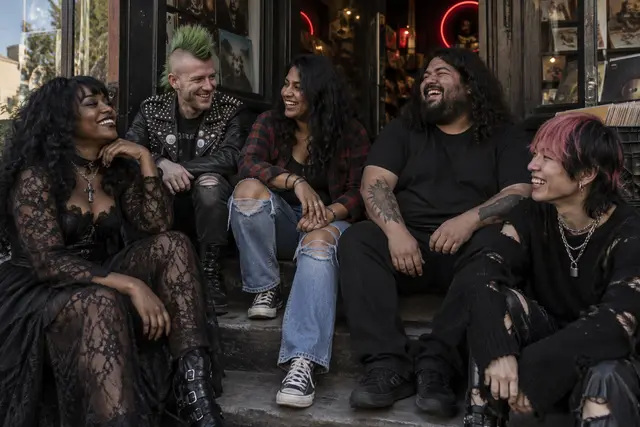
- Dyed hair, visible tattoos, layered necklaces, tidy silhouette
- Platform shoes if they are safe for your job and your commute
- Dark lipstick on non-client-heavy days
- Harness-inspired belt over a plain dress, if your workplace is chill enough
This is not “anything goes.” It is more like “the office has accepted that you are the weather event.”
Level 4: Full crypt diplomat
Save this for workplaces that genuinely celebrate dramatic style, themed days, fashion-forward offices, creative events, alt-owned businesses, photo days where you control the vibe, or after-work plans when you can change a few pieces.
The vibe: dramatic, memorable, still adult.
Examples:
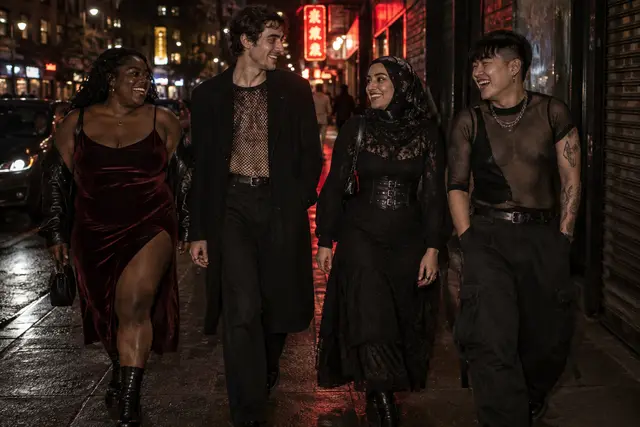
- Velvet blazer, ornate jewelry, dark lip, lace accents
- Big boots, long coat, dramatic monochrome layers
- Sharp eyeliner, statement hair, layered black textures
- Romantic goth touches: ruffles, brocade, long silhouettes
The trick is knowing when this level helps you and when it makes your day harder for no reward.
Start with the policy, then read the room
The written dress code matters. The unwritten one matters too.
In the U.S., the EEOC says employers may generally establish dress codes that apply to all employees or to employees within job categories. That does not mean every rule is automatically fair or legal; rules can raise issues if they are applied unevenly or conflict with protected rights. For day-to-day survival, though, your first task is simple: get the policy, read it, and notice the exact language. (eeoc.gov)
Look for words like:
- “Business casual”
- “Professional appearance”
- “No visible tattoos”
- “No facial piercings”
- “Natural hair colors”
- “Closed-toe shoes”
- “No offensive graphics”
- “No ripped clothing”
- “Uniform required”
- “Client-facing attire”
- “Safety requirements”
Then look at what people actually wear. A policy might say business casual, but the office reality might be black jeans, cardigans and sneakers. Or the policy might sound relaxed, but everyone dresses like they are about to defend a haunted merger.
For interviews, career guidance from Oregon State University suggests reviewing a company’s website, LinkedIn and social media to understand workplace culture and openness to tattoos, piercings and attire. That is useful for alt people because it turns anxiety into detective work. You are not guessing in a panic. You are gathering clues like a stylish little office cryptid. (career.oregonstate.edu)
The interview outfit formula for alt people
A job interview is not the time to cosplay as someone you despise. It is also not always the time to show your rarest, loudest, most buckled-up final form.
Try this formula:
One notch sharper than their daily clothes + one honest alt detail + zero distractions from your face and words.
Step 1: Find the likely baseline
Use employee photos, recruiter emails, job listing language and industry norms.
- If the company photos show suits: wear dark professional tailoring.
- If they show polos and jeans: wear black trousers or dark jeans with a blazer.
- If they show hoodies and sneakers: still polish up a little.
- If it is retail, food service, health care, lab, warehouse or trades: prioritize safety, cleanliness and role requirements.
Step 2: Keep one visible alt signal
This matters. If you hide everything, you may get the job but feel like you snuck in wearing someone else’s skin.
Good interview signals:
- Black-on-black outfit
- Silver ring stack, kept minimal
- Dark nail polish
- Subtle eyeliner
- Dark floral shirt
- Small nose stud if you usually wear it and the field is not strict
- Neat boots instead of plain dress shoes
- Black blazer with an interesting texture
Step 3: Decide on tattoos and piercings strategically
There is no single correct answer. A throat tattoo in a conservative client-facing role will land differently than a small forearm tattoo at a design studio. A septum ring may be no big deal in one workplace and a policy issue in another.
Ask yourself:
- Is this role customer-facing?
- Does the job involve safety gear?
- Do employees in public photos show body art?
- Would covering this make me feel calm or dishonest?
- If I reveal it later, would it violate a policy?
A practical compromise: cover or minimize what you can for the first conversation if the industry is strict, then ask about appearance policies once the job feels mutual. Not timid. Tactical.
Tattoos at work: the realistic guide
Visible tattoos are more accepted in many workplaces than they used to be, but acceptance is uneven. Industry, region, role, management and customer base all matter.
Tattoo placement makes a difference
Workplaces often react differently to:
- Upper arm tattoos hidden by sleeves
- Forearm tattoos visible at a desk
- Hand tattoos
- Neck tattoos
- Face tattoos
- Horror imagery
- Religious imagery
- Political imagery
- Words that can be read across a meeting table
If your ink is easily covered, you have options. If it is always visible, your strategy shifts toward choosing workplaces where visible body art is not treated like a scandal.
What to ask before accepting a job
You can ask plainly:
- “Is there a written appearance policy I can review?”
- “Are visible tattoos allowed in this role?”
- “Are there different expectations for client meetings?”
- “Does the policy change by location or department?”
The goal is not to beg for permission to exist. The goal is to avoid surprise rules after you have already rearranged your life.
Red flags around tattoos
Be cautious if you hear:
- “We do not have a policy, but the owner hates tattoos.”
- “It depends who complains.”
- “Just cover them until you are hired.”
- “We are like a family here, so we expect a certain image.”
- “It is not written down, but you will know if it is a problem.”
Vague rules can become selective rules. Selective rules are where many alt people get stuck.
Piercings at work: studs, hoops and the tiny metal politics
Piercings are small, but workplaces can act like a nostril hoop is a portal opening over the copier.
Think in three categories
Low-friction:
- Ear piercings
- Small nostril stud
- Small septum jewelry flipped up if needed
- Simple jewelry in neutral metal
Medium-friction:
- Multiple facial piercings
- Larger hoops
- Eyebrow piercings
- Lip rings
- Visible stretched ears
High-friction:
- Jewelry that conflicts with masks, helmets, headsets or safety gear
- Sharp spikes near equipment
- Anything that could snag in physical work
- Jewelry prohibited by food handling, health care or lab rules
This is not about shame. It is about keeping your face attached and your paycheck intact.
Build a piercing work kit
If your workplace allows some jewelry but not all, keep a tiny kit:
- Clear retainers if safe and appropriate for your piercings
- Small studs
- Plain hoops
- A compact mirror
- A clean storage case
- Backup backs or balls
Do not change fresh piercings too early just for a shift if your piercer told you not to. Healing tissue does not care about quarterly goals.
Hair color, natural hair and the “professional” trap
Hair is where “professional” can get loaded fast. Blue hair, shaved sides, black dye, liberty spikes, locs, braids, curls, headwraps, wigs, long hair on men, buzzcuts on women, and androgynous cuts can all trigger opinions that have nothing to do with job performance.
Here is the key distinction:
Alt hair choices like neon green dye may be treated as style choices under a workplace policy.
Race-associated hair texture and protective styles can involve civil rights protections depending on location and context. The Legal Defense Fund notes that there is no single nationwide CROWN Act protection, and state-level protections vary, so workers dealing with hair discrimination should check local rules and get qualified advice if needed. (naacpldf.org)
If you have fantasy color
Fantasy color can work in many offices if the rest of your look is neat and the color is maintained. Faded neon with split ends reads differently from glossy cobalt in a clean bob or tidy curls. That is annoying, but useful to know.
Ways to make vivid hair feel more office-ready:
- Keep the cut intentional.
- Refresh color before interviews if you can.
- Pair bright hair with simpler clothes.
- Use sleek styles for formal meetings.
- Try peekaboo color if you want flexibility.
- Use dark roots or deep jewel tones for a softer effect.
If you have big goth hair
Backcombed drama is beautiful. It is also a logistical event.
For workdays, consider:
- Lower-volume teasing
- Half-up styles
- Sleek ponytails
- Braids
- Claw clips in black or metal tones
- Soft waves with dark accessories
- A dramatic part instead of full height
Save the full storm cloud for places that deserve it.
The alt workwear capsule wardrobe
A capsule wardrobe sounds suspiciously beige, but it does not have to be. Think of it as your “I woke up late and still look like a competent bat” system.
The core pieces
| Piece | Why it works | Alt upgrade |
|---|---|---|
| Black trousers | Clean, flexible, easy to repeat | Wide-leg, tapered, pleated or cropped with boots |
| Dark blazer | Instant structure | Velvet trim, satin lapel, oversized shape or cropped cut |
| Black knit top | Works alone or layered | Mock neck, ribbed texture, square neck |
| Button-up shirt | Interview and meeting friendly | Black, charcoal, oxblood, dark floral, subtle stripe |
| Dark jeans | Great if allowed | Straight-leg black, no heavy distressing for stricter days |
| Midi skirt | Polished without feeling bland | Pleats, asymmetry, subtle lace layer |
| Work dress | One-piece solution | Black, dark green, burgundy, gray plaid |
| Boots | The soul remains | Keep them clean; choose lower platforms for long days |
| Cardigan | Office temperature armor | Long black, cropped, striped, textured knit |
| Plain belt | Pulls outfits together | Silver buckle, western shape, grommets if allowed |
The texture trick
All-black outfits can look flat under office lights. Texture saves them.
Mix:
- Matte cotton
- Ribbed knit
- Smooth suiting
- Soft velvet accents
- Faux leather details
- Lace in small doses
- Mesh layered under solid pieces
- Dark denim
- Satin scarf or tie
A black outfit with three textures looks intentional. A black outfit with one tired fabric can look like laundry day won.
The color palette that still feels alt
You are allowed to wear colors that look like they were found in a cursed garden.
Try:
- Black
- Charcoal
- Bone
- Oxblood
- Wine
- Deep plum
- Forest green
- Navy so dark it is basically suspicious
- Rust
- Steel gray
- Dark brown
- Dusty mauve
If your style leans emo or scene, use sharper contrast: black with white, red, hot pink accents, checkerboard details or striped sleeves. If your style leans metal, go for black denim, heavy boots, dark utility pieces and clean silver hardware. If your style leans punk, try tartan in smaller doses, patched jackets outside work, and one strong accessory at a time.
Outfit formulas by workplace vibe
Strict corporate
Formula: black trousers + dark blouse or button-up + blazer + polished shoes + one piece of jewelry.
Keep makeup clean. Keep silhouettes sharp. Avoid visible rips, slogans, huge hardware and noisy chains.
Good alt detail: dark nails, silver ring, black velvet hair bow, subtle eyeliner.
Business casual office
Formula: black jeans or trousers + knit top + cardigan or blazer + boots.
This is where most alt workwear thrives. You can rotate textures, jewelry, dark colors and hair accessories without causing a policy séance.
Good alt detail: dark floral shirt, small chain necklace, striped socks, cropped blazer.
Creative workplace
Formula: statement piece + simple base + practical shoes.
If you wear a dramatic jacket, keep the rest simple. If you wear big boots, keep the outfit clean. If your hair is neon, let it be the headline.
Good alt detail: visible tattoos, dyed hair, layered jewelry, interesting silhouettes.
Retail, salon, studio or nightlife-adjacent job
Formula: brand-appropriate style + comfort + safety.
You may be allowed to look more visibly alt, but you still need to move, lift, stand, bend, clean, sell, cut, style or run around without suffering.
Good alt detail: darker makeup, expressive hair, boots with actual support, layered black basics.
Warehouse, lab, food service, health care or trades
Formula: safety first + dark practical basics + personality where allowed.
Closed-toe shoes, tied-back hair, minimal jewelry and uniform rules are not aesthetic attacks if they are about safety. Put the flair into approved socks, undershirts, hair color, patches on your own bag, or after-shift layers.
Good alt detail: black work pants, dark undershirt, subtle studs, dyed hair if permitted.
Makeup that reads alt but still work-ready
Makeup rules are wildly different by workplace. Some places do not care. Some places care in a way that feels teleported from a dusty employee handbook.
Low-risk alt makeup
- Soft smoky liner
- Tightlined eyes
- Brown-black or charcoal shadow
- Dark berry lip stain
- Black or deep red nails
- Matte skin or natural finish
- Defined brows
- Subtle contour
Medium-risk alt makeup
- Winged eyeliner
- Black lipstick
- Graphic liner
- Heavy blush placement
- White inner-corner highlight
- Very long nails
- Dramatic false lashes
High-risk alt makeup
- Full corpse paint influence
- Extreme graphic shapes
- Heavy dripping liner
- Contact lenses that change the eye dramatically
- Makeup that could transfer onto masks, uniforms or products
You can still have fun. Just match the drama to the day. A spreadsheet day can handle more eyeliner than a first client meeting with people who still print emails.
Remote work: waist-up goth diplomacy
Remote work creates a special creature: the video-call torso.
Your outfit needs to look intentional in a small rectangle. Details near your face matter more than shoes, unless you stand up and reveal pajama chaos to the entire department.
Good remote alt choices:
- Black mock neck
- Dark cardigan
- Button-up with collar detail
- Interesting earrings
- Neat hair or a deliberate messy style
- Dark lip if your camera does not turn it into a blur
- Clean background with one or two personal objects
Alt Chat’s Realm feed and Night Chats are for hanging out as your full weird self; work video calls are more like controlled broadcasts from your lair. You can still be you. Just check what the webcam does to your eyeliner before joining.
The “client visit in 20 minutes” emergency kit
Every alt worker eventually faces surprise formality. A client appears. A director visits. A meeting gets upgraded. The office energy shifts from “casual spreadsheet cave” to “please look funded.”
Keep a small emergency kit at work or in your bag:
- Black blazer
- Lint roller
- Hair tie or clip
- Plain earrings or retainers
- Blotting paper or tissues
- Neutral lip balm
- Stain wipe
- Backup tights or socks
- Simple flats or cleaner shoes if you commute in monster boots
- Tiny sewing kit or safety pins
This is not selling out. This is armor management.
How to talk to a manager about your look
You do not need to overexplain your identity. Keep it practical.
If you are asking before starting
Try:
“Could you send me the dress code or appearance policy before my first day? I want to make sure I’m prepared.”
This is clean. No apology. No nervous essay about being goth since age thirteen.
If you want clarity about a specific item
Try:
“I usually wear a small nose ring. Is that allowed in this role, or should I switch to a stud during shifts?”
Or:
“I have visible forearm tattoos. Are those okay for regular office days, and should I cover them for client meetings?”
If a rule feels uneven
Try:
“I want to follow the policy consistently. Can you point me to the written rule this relates to?”
That sentence is a tiny candle in a dark hallway. It asks for fairness without starting a courtroom drama in the break room.
When the dress code gets personal
Some feedback is normal: “Closed-toe shoes are required,” “No ripped jeans,” “Please wear the uniform shirt.” Fine.
Some feedback is suspicious: “You look intimidating,” “Can you be less goth?” “Your natural hair is distracting,” “That style is not feminine enough,” “Clients prefer a cleaner look,” “People like you do not fit our brand.”
The EEOC’s materials on appearance and grooming standards note that standards can raise discrimination issues when they connect to protected bases such as race, religion, national origin, sex or disability. This is not legal advice, but it is a reason to document what happened, save written messages, compare how rules are enforced and talk to someone qualified if the stakes are high. (eeoc.gov)
Keep a simple record
If something feels off, write down:
- Date
- Time
- Who was there
- What was said
- The policy cited, if any
- What other employees are allowed to wear
- Screenshots or emails, if relevant
Do not rely on memory alone. Memory is a messy little raccoon when stress gets involved.
Alt workwear mistakes that are easy to fix
Mistake 1: Dressing for rebellion instead of strategy
Sometimes the outfit is technically amazing but wrong for the room. If your goal is to get hired, pass probation, lead the meeting or make rent, strategy is allowed.
You can be subcultural and smart at the same time.
Mistake 2: Wearing painful shoes as a personality trait
We have all done it. The boots looked incredible. By 2 p.m., your feet were composing a farewell note.
Work shoes need support, traction and commute survival. Save the gorgeous ankle-destroyers for shorter events.
Mistake 3: Forgetting sound
Chains, charms and stacked bracelets can be fun until you sound like a haunted cutlery drawer on every keyboard stroke.
Do a sound test at home. Walk. Sit. Type. Reach. If your outfit announces every movement, maybe reduce the jingle.
Mistake 4: Ignoring fabric under office lighting
Thin black fabric can turn sheer under bright lights. Velvet can collect lint like it has a side quest. Faux leather can squeak. Mesh can read more nightlife than you planned.
Test outfits near a window and under harsh light.
Mistake 5: Saving your identity only for weekends
If you feel erased Monday through Friday, resentment builds. Find tiny daily anchors: a ring, a song on your commute, a dark cardigan, your profile Anthem on Alt Chat, a black notebook, a scent, a playlist, a lunch walk past the weird old building you love.
Style is not only what other people see. It is also how you stay connected to yourself.
Building confidence when you are the only alt person at work
Being the lone goth, emo or punk at work can feel funny, lonely and powerful all at once. You become “the one with the boots.” People ask if you love Halloween. Someone says, “I used to be emo,” then describes owning one black shirt in 2009.
You can handle it with humor and boundaries.
Easy replies for repetitive comments
“Do you always wear black?”
“Mostly. It makes laundry easier and my soul agrees.”
“Are you going somewhere after work?”
“Eventually, yes. Spiritually, always.”
“You look scary.”
“Perfect, then the spreadsheets will behave.”
“Is that a real tattoo?”
“Yep. Anyway, about the deadline…”
Find your people outside work
Work does not have to provide your whole social world. In fact, it usually should not. If your office is aggressively beige, build your weird corner elsewhere: local shows, online groups, small chat rooms, hobby nights, record stores, book clubs, and spaces like Alt Chat, where alt people can meet, chat and hang out without doing the “so what does goth mean?” speech every time.
For the bigger picture, read what does alt mean or third places for alt people. Your job can pay the bills. Your life gets to be wider than the break room.
Quick outfit recipes for real workdays
The Monday resurrection
- Black trousers
- Soft black sweater
- Silver hoops or studs
- Clean boots
- Long coat
Low effort. Still alive. Barely, but stylishly.
The interview without identity loss
- Charcoal blazer
- Black button-up
- Black trousers
- Polished boots
- One ring or pendant
- Neat hair
Professional, but not beige surrender.
The “I have a meeting and a show later” outfit
- Black jeans or trousers
- Sleeveless black top under blazer
- Boots
- Subtle eyeliner for day
- Dark lipstick in your bag for later
- Statement necklace packed separately
Work at 3. Creature of the night by 8.
The office emo classic
- Slim black pants
- Striped long sleeve under a black tee or sweater
- Cardigan
- Clean sneakers or boots
- Side part or soft fringe
If your workplace dislikes visible graphic tees, keep the top plain and let the stripes do the emotional labor.
The corporate goth power move
- Black midi dress
- Structured blazer
- Opaque tights
- Low boots
- Dark red nails
- Simple silver jewelry
If you want a lighter version, take the corporate goth style quiz for fun, then build the real outfit around your workplace rules.
The punk-but-payroll-friendly fit
- Dark plaid trousers
- Plain black tee or knit top
- Black blazer or overshirt
- Boots
- One chain, not seven
You still look like you have opinions. You also look like you can join the budget meeting without setting off alarms.
The final mirror check
Before leaving, ask five questions:
- Can I do my job safely in this?
- Does it follow the written policy as far as I understand it?
- Is the loudest part of the outfit intentional?
- Would I feel okay if I unexpectedly met a client, director or recruiter today?
- Do I still feel like myself?
That last one matters. Alt workwear is not about becoming acceptable to people who think personality is a dress code violation. It is about learning the map, choosing your battles and getting through the workday with your confidence intact.
Wear the black. Polish the boots. Read the policy. Keep the weird little spark alive under the blazer.
FAQ
How can I dress alt at work without breaking the dress code?
Start with the written policy, then build your outfit around silhouette, texture and accessories instead of shock value. Black layers, polished boots, subtle hardware, dark florals, sharp tailoring and neat grooming can say alt without turning every workday into a dress code meeting.
Should I hide tattoos and piercings for a job interview?
It depends on the role, industry and workplace culture. If you are unsure, dress one notch more polished than the job’s daily vibe, research employee photos, and ask about the appearance policy after the conversation turns practical.
What is corporate goth?
Corporate goth is goth-inspired style translated for offices, interviews and client-facing settings. Think black tailoring, lace or velvet in small doses, silver jewelry, sleek boots, dark nails and dramatic-but-controlled details.
Can my job tell me what to wear?
In many workplaces, employers can set dress and grooming rules, especially for safety, uniforms or customer-facing roles. Rules can get complicated when they touch protected traits, religion, disability accommodations or race-based hair discrimination, so check your local rules or talk with a qualified professional if the issue feels serious.