Industrial Music: A Beginner's Guide

Industrial music sounds like a factory learned to dance. It's loud, mechanical, sometimes abrasive and often surprisingly catchy, and it sits right next to goth in every dark club worth going to. If you've ever heard a goth DJ switch from The Cure to something that sounds like a drum machine fighting a steel mill, that was probably industrial.
This guide covers where industrial came from, the bands that matter, the main subgenres and where to start listening.
Where industrial music came from
In the mid-1970s, a group of British artists called Throbbing Gristle started making music out of noise, tape loops, synthesizers and found sounds. They also started a label, Industrial Records, and that's where the genre name comes from. Their early releases were less about songs and more about confronting the listener.
Around the same time and soon after, other experimental acts pushed in similar directions:
- Cabaret Voltaire from Sheffield, who mixed tape experiments with electronic rhythms
- SPK from Australia, known for harsh noise
- Einstürzende Neubauten from Berlin, formed in 1980, who played actual metal, power tools and building materials as instruments
- Laibach from Slovenia, formed in 1980, who mixed military imagery with heavy, theatrical sound
This first wave was arty and noisy. It wasn't club music yet. That came next.
The second wave: industrial gets a beat
In the 1980s, industrial got rhythm. Drum machines and synths turned the noise into something you could move to.
EBM
Front 242, from Belgium, helped define electronic body music (EBM), a style with pounding, steady beats and sequenced basslines. Nitzer Ebb from England and DAF from Germany are other key names. EBM is still a staple of goth and industrial club nights.
Skinny Puppy and the Canadian scene
Skinny Puppy, formed in Vancouver in 1982, made dark, twisted electronic music with distorted vocals and horror-movie atmosphere. They influenced almost everyone who came after. Bill Leeb, who was briefly in Skinny Puppy, went on to form Front Line Assembly, another cornerstone band.
Wax Trax! and Chicago
The Chicago label Wax Trax! Records became the American home of industrial in the 1980s, releasing music by Front 242, KMFDM and Ministry-related projects. Ministry, led by Al Jourgensen, started out closer to synth-pop and turned into a crushing guitar-and-machine band on albums like The Mind Is a Terrible Thing to Taste (1989) and Psalm 69 (1992).
KMFDM, formed in Germany in 1984 by Sascha Konietzko, brought guitars, humor and big choruses. Their album art is instantly recognizable.
The 1990s: industrial goes mainstream
Nine Inch Nails, Trent Reznor's project, released Pretty Hate Machine in 1989 and The Downward Spiral in 1994. NIN combined industrial textures with pop-level songwriting, and suddenly industrial was on rock radio and MTV. Reznor later moved into film scores with Atticus Ross, and the pair won an Oscar for The Social Network.
At the same time, industrial metal got heavier:
- Godflesh from Birmingham, England, built huge, slow, grinding songs around drum machines
- Fear Factory blended death metal with machine-precise rhythms
- Rammstein, formed in Berlin in 1994, became the face of Neue Deutsche Härte, a German style of heavy, industrial-tinged metal with massive live shows
If you love the heavier side, our metal subgenres explained guide covers how industrial metal fits next to its cousins.
Subgenres to know
Industrial has split into a lot of styles. Here's a quick cheat sheet:
- Power electronics and noise – harsh, mostly beatless and extreme. The original spirit of industrial.
- EBM – danceable, steady and rhythmic. Front 242, Nitzer Ebb.
- Electro-industrial – darker, more layered and atmospheric. Skinny Puppy, Front Line Assembly.
- Industrial rock – songs with guitars, hooks and machines. Nine Inch Nails, KMFDM.
- Industrial metal – heavy riffs plus programming. Ministry, Godflesh, Fear Factory.
- Aggrotech – aggressive, distorted vocals over hard club beats, popular in the 2000s. Combichrist, Hocico from Mexico, and Suicide Commando from Belgium.
- Neue Deutsche Härte – German heavy industrial rock. Rammstein, Oomph!.
Industrial also overlaps with darkwave and other goth styles. Our guide to goth music genres shows how they all connect.
Newer industrial bands worth hearing
Industrial is very much alive. A few acts carrying it forward:
- Author & Punisher – Tristan Shone builds his own machines to perform with, and the result is crushing
- HEALTH – noisy, heavy and melodic, with lots of collaborations across metal and electronic music
- 3TEETH – modern industrial metal from Los Angeles
- Youth Code – a raw, punk-flavored take on EBM and industrial
Where to start listening
Don't start with the noisiest stuff unless you're feeling brave. Try this path instead:
- Nine Inch Nails – Pretty Hate Machine – The most accessible door in.
- Front 242 – Front by Front – Classic EBM you can dance to.
- Skinny Puppy – Too Dark Park – Darker and weirder.
- Ministry – Psalm 69 – Heavy, fast and furious.
- Rammstein – Mutter – Huge riffs and singalong drama.
- Throbbing Gristle – 20 Jazz Funk Greats – Despite the title, it's neither jazz nor funk. A great way to hear the original weirdness.
Once you know what you like, follow it. If you love the dance side, look for EBM and electro-industrial nights. If you love the heavy side, go deeper into industrial metal.
What to wear to an industrial night
There's no dress code, but industrial nights have their own looks, and they're a lot of fun to play with:
- Black basics with a hard edge – combat boots, cargo pants, mesh tops and leather
- Cyber goth – neon accents, synthetic dreads, goggles and UV-reactive pieces that glow under black light
- Military surplus – jackets, harnesses and utility belts, a nod to the EBM look of the 1980s
- Comfortable shoes – seriously, you'll be dancing for hours, and industrial floors get stompy
The best outfit is the one you can move in. Nobody will mind if you show up in a band shirt and jeans.
Industrial in the goth scene
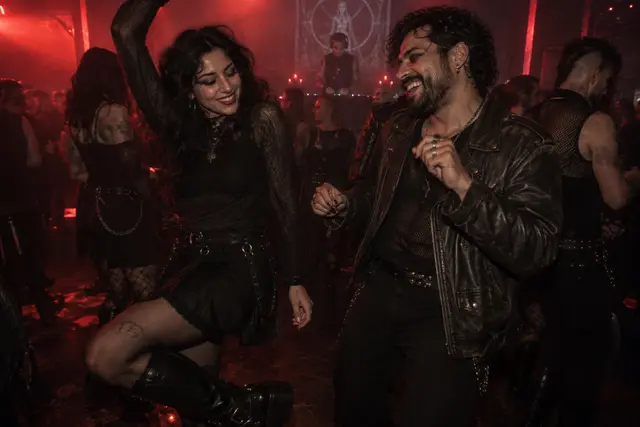
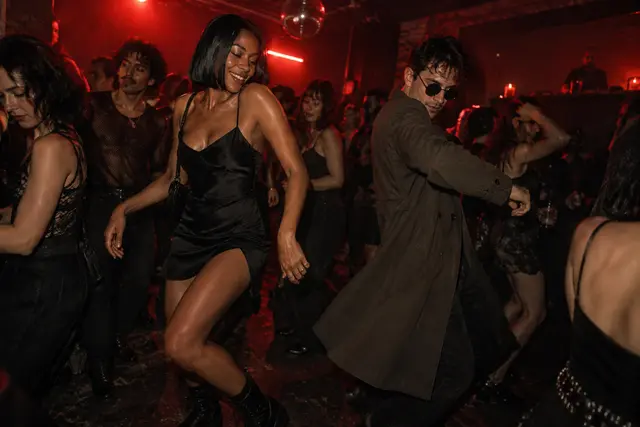
Industrial and goth have shared dance floors since the 1980s. Many goth club nights play both, and plenty of people drift between the two scenes all night. It's very normal to see someone in a velvet dress and someone in cyber goth gear dancing to the same Front Line Assembly track.
If you want to find people who love this stuff as much as you do, Alt Chat has live chat rooms and groups where you can ask for recommendations or find someone to go to a club night with. And if your taste runs more synth than steel, our list of darkwave artists is a great next stop.
FAQ
What is industrial music?
Industrial music is a genre that started in the mid-1970s, built on noise, machine sounds, tape loops and electronics instead of traditional rock songwriting. Over time it branched into danceable styles like EBM and heavy styles like industrial metal.
Who started industrial music?
The British group Throbbing Gristle is usually credited with starting it. They founded Industrial Records in the 1970s, and the label's name gave the whole genre its name.
Is Nine Inch Nails industrial?
Yes. Nine Inch Nails is often called industrial rock, and albums like The Downward Spiral brought industrial sounds to a huge mainstream audience in the 1990s.
What is the difference between industrial and EBM?
EBM, or electronic body music, is a more danceable offshoot of industrial with steady electronic beats and sequenced basslines. Industrial is the broader, often noisier umbrella that EBM grew out of.