Stage Diving Etiquette: Crowd Surf Without Being a Menace

A great stage dive looks like a magic trick: one second there is a sweaty punk on the edge, the next there is a human bat gliding across a sea of hands. A bad stage dive looks like a laundry bag full of boots being thrown at strangers. This guide is for keeping the first one alive and sending the second one directly to goblin jail.
Stage diving etiquette is not about making shows boring. It is about keeping punk, hardcore, metalcore, thrash and heavy shows intense without turning the room into a lawsuit-shaped trash fire. If you want chaos, beautiful. Just make it the kind where everyone gets to go home with their teeth, friends and jacket intact.
Why stage diving etiquette is suddenly everyone’s problem again
Crowd surfing and stage diving never vanished, but they are back in the conversation because big mixed-genre shows are pulling together fans with very different pit languages. Vans has framed the revived Warped Tour as a mix of punk, skate culture and DIY energy, which means younger fans, returning elder scene gremlins, pop-punk kids, metalcore lifers and hardcore dancers are sharing space again. That can be amazing. It can also mean five different ideas of “normal pit behavior” colliding at once. (vans.com)
At the same time, people are arguing more openly about pit manners, crowd surfing and stage diving online. The FADER wrote in 2026 about antisocial crowd behavior creeping into live music spaces, especially when new fans learn concert behavior from viral clips instead of tiny rooms where someone immediately says, “Hey, don’t do that.” (thefader.com) A Reddit thread about stage diving culture posted on November 12, 2026 shows fans still debating how much surfing is fun, how much is too much, and how rough things have gotten in some rooms. (reddit.com)
So, yes: this is a manners guide. But not “stand still with your hands folded” manners. More like “don’t dropkick a stranger’s glasses into another dimension” manners.
Stage diving, crowd surfing and moshing are not the same thing
People use these words like they are interchangeable, then wonder why the room turns into a confused raccoon fight. Here is the quick version.
| Term | What it means | Main risk | Best rule |
|---|---|---|---|
| Moshing | Moving, pushing, running or dancing in the pit | People falling or getting hit | Keep it in the pit and help people up |
| Crowd surfing | Being carried above the crowd by other fans | Kicking heads, falling, hurting catchers | Ask, stay flat, get down fast |
| Stage diving | Jumping from the stage or platform into the audience | Landing on unready people | Only do it where it is clearly welcomed |
| Hardcore dancing | Two-stepping, spin kicks, windmills and floor-punching styles | Hitting people outside the dance zone | Control your limbs and read the edge |
| Crowdkilling | Targeting people at the pit edge or outside the pit | Injuring bystanders, starting fights | Don’t be that person |
If you want the broader pit basics, read Mosh Pit Etiquette: How to Have Fun and Stay Safe. If you want to test your personal goblin threat level, the Crowdkilling Etiquette Quiz is waiting like a bouncer with eyeliner.
The golden rule: consent has to travel through the crowd
The biggest myth about crowd surfing is that the person going up is the only one taking the risk. Nope. Everyone underneath becomes part of the stunt.
That includes:
- the 5'2 fan trying to see their favorite chorus;
- the person wearing glasses;
- the person with chronic pain who picked the “safe” edge;
- the photographer with gear to protect;
- the security worker catching bodies all night;
- the person who came alone and does not want surprise boots in their neck.
Real stage diving etiquette starts with this: your fun cannot require strangers to absorb your full body weight without warning.
That does not mean nobody can surf. It means you need a room that is saying yes. A yes-room has raised hands, dense bodies, alert fans, security expecting surfers, and a band that is not actively telling people to chill. A no-room has open floor, tired people, crossed arms, phones up, tiny clusters, confused faces, a strict venue, or security already pulling people out.
If the crowd is not ready, your “iconic dive” becomes a sack of boots with a haircut.
Check the rules before you become a flying problem
A lot of venues and event organizers do not allow stage diving or crowd surfing. Some policies are extremely direct. Live Nation Switzerland’s terms say endangering other visitors through crowd surfing, circle of death or pogo dancing is prohibited and can lead to removal from the event. (livenation.ch) Court documents from U.S. cases have also described Live Nation venue rules and signage prohibiting moshing or surfing, with people subject to ejection if they participate. (public.courts.in.gov)
This matters because “the scene allows it” does not override the actual room you are standing in. A basement hardcore show, a punk fest stage, a seated theater, a stadium floor and a small all-ages venue can have completely different rules.
Before you try anything airborne, look for:
- posted signs at the entrance;
- security announcements;
- barricade setup;
- the event FAQ;
- what other fans are doing;
- how staff react to the first surfer;
- the band’s requests from the stage.
If staff are removing surfers, do not argue like you are defending the Constitution of Riff Mountain. Get down, stay cool and keep your night.
The pre-dive checklist: five seconds that save everyone grief
Before you dive, surf or lift a friend, run this tiny mental checklist.
1. Is the crowd dense enough?
A crowd has to be packed enough to support weight. If there are big gaps, do not jump. Human beings are not trampoline foam.
A safe-ish crowd surf zone looks like:
- shoulders close together;
- hands already going up;
- fans facing the stage, not wandering around;
- people responding when someone points upward;
- no huge empty crater between you and the pit.
If the floor looks like a half-empty bowling alley, your flight has been canceled.
2. Are people expecting bodies overhead?
If surfers have been going up all set and the crowd is handling it, that is a green light. If nobody has surfed and the room is mostly still, think twice.
The first surfer changes the whole crowd contract. Do not be the person who starts a trend the room did not request.
3. Are you wearing dangerous gear?
Boots are cool. Boots to the skull are less cool.
Before going up, think about:
- steel-toe boots;
- heavy platforms;
- spiked jackets;
- big chains;
- sharp rings;
- backpacks;
- loose keys;
- wallet chains that could snag;
- giant hair accessories;
- anything that could whack, scratch, choke or tangle.
If your outfit looks like it could survive a haunted construction site, maybe keep both feet on the floor.
4. Are you sober enough to control yourself?
You do not need to be a perfect monk of hydration. But if your balance is gone, your judgment is gone and your limbs have entered wet-noodle mode, do not surf. A retrospective medical analysis of mosh-pit-related injuries noted high rates of medical-aid presentations at the events studied, and alcohol was one of the factors tracked in that event medicine context. (pubmed.ncbi.nlm.nih.gov)
Translation: the pit is already spicy. Do not add “ragdoll with no steering” to the menu.
5. Do you know where you will land?
A real stage dive needs a landing plan. You are not launching into destiny. You are launching into people.
Look for:
- hands up;
- heads turned toward you;
- enough people in front;
- no obvious smaller or unready fans directly below;
- no security gap;
- no monitors, cables or barricade edges in your path.
If you cannot see a safe landing zone, you do not have one.
How to stage dive without being the villain of the group chat
Stage diving is more intense than crowd surfing because you are adding height, speed and surprise. Done right, it is pure punk theater. Done wrong, it is a human bowling ball.
Do: make eye contact
If you are on the stage edge, look at the crowd. Point. Raise your eyebrows. Give people half a second to prepare. If they reach up, great. If they back away, do not jump. That is not “weak energy.” That is information.
Don’t: jump feet-first
Feet-first diving is how you turn your boots into face missiles. Go flat, chest or side first, with your legs controlled. You want to spread your weight across many hands, not spear one person with a platform sole.
Do: keep your limbs tucked and controlled
You are not a haunted windmill. Keep elbows in. Keep knees from flailing. Do not kick to “swim.” The crowd will move you.
Don’t: dive with a backpack
Backpacks hit faces, snag hair, catch jewelry and add weird weight. Coat check it, stash it safely with a trusted friend, or skip the dive.
Do: get off the stage quickly if you are not supposed to be there
Some DIY rooms tolerate fans onstage. Many venues do not. If you climb up and security is already moving toward you, get down. The show is not improved by a tug-of-war between you, two security workers and a mic stand.
Don’t: stage dive during quiet parts unless the band clearly welcomes it
The slow atmospheric intro, the emotional acoustic section, the doom build where everyone is staring into the void like a Victorian ghost? Maybe not your launch window.
How to crowd surf like you have friends under you
Crowd surfing is not just “get lifted and hope.” There is a right way to be carried.
Ask before going up
The classic move is turning to the people near you and asking, “Can I go up?” If they say yes, they will usually help. If they look exhausted, annoyed or confused, do not force it.
Tiny script:
“Can you lift me on three?”
Then actually count. Do not suddenly leap backward onto strangers like a cursed trust fall.
Stay flat
A flat surfer spreads weight. A curled-up surfer becomes a bowling ball. A vertical surfer becomes a falling tree. Lie back or stomach-down with your body steady and your arms close enough that you are not smacking everyone.
Keep boots low
Your feet are the danger zone. Keep them from swinging. If you wear heavy footwear, be extra careful or skip surfing altogether.
Move with the crowd, not against it
Do not fight the direction. If people are moving you toward the front, go toward the front. If they are sending you sideways to a safer exit, accept the route. You are cargo with eyeliner. Be polite cargo.
Get down when told
If security taps you, catches you or points down, get down. If fans start lowering you, help them. Do not demand another lap. This is not a lazy river for punks.
How to lift or catch someone without wrecking your own night
You do not have to lift anyone. Seriously. If your back hurts, your shoulder is bad, you are short, you are tired, you are not comfortable, or you simply do not want to, you can step away.
If you do help, use your brain and your legs.
For lifting
- Ask: “You going up?”
- Lift from sturdy areas like hips, thighs or upper back, not random limbs.
- Count together.
- Do not grab private areas. Ever.
- Do not throw someone like a sack of potatoes.
- Make sure other hands are ready before releasing weight.
For catching
- Keep your hands up near shoulders, back or legs.
- Pass the person along quickly.
- Protect your neck and face.
- Move them toward more hands, not an empty spot.
- If they start falling, help lower them instead of panic-launching them.
The best crowd is not the strongest crowd. It is the crowd that communicates.
If someone falls, the show stops for three seconds
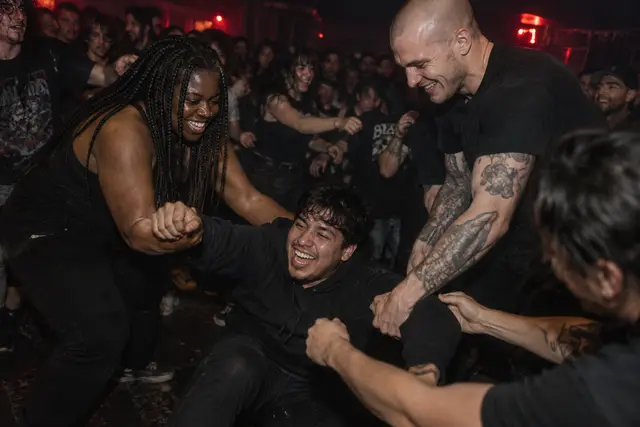
This rule is ancient and holy: if someone falls, pick them up.
Not after the breakdown. Not after the chorus. Now.
Do this:
- Put a hand out.
- Create a little space.
- Help them stand.
- Ask, “You good?”
- Point them toward the edge if they need out.
- Return to chaos only after they are clear.
This is the difference between a pit and a mob. A pit has rules, even when it looks like a tornado wearing black jeans.
Protect the edges: the pit border is not a target range
The edge of the pit is where a lot of tension happens. Some people stand there because they want light contact. Some stand there because they got pushed there. Some are guarding friends, filming one song, or trying to breathe.
Good etiquette:
- If someone’s back is turned, do not hit them.
- If someone is holding a drink, camera, cane, phone or merch, avoid them.
- If someone is clearly trying to leave, open a path.
- If someone is smaller than you, adjust your force.
- If someone says stop, stop.
Yes, the edge can be active. No, that does not mean you get to use strangers as padded walls.
If you are still unsure where the line is, take the Concert Etiquette Quiz for Metal and Punk Shows and let the internet lightly roast you in private.
Smaller fans, disabled fans and “I paid to be here too” energy
A good scene makes room for different bodies. That includes short fans, fat fans, disabled fans, older fans, queer and trans fans, people with anxiety, people recovering from injuries, and people who love heavy music but do not want to be body-checked into the merch table.
Nobody has to earn their place by surviving avoidable nonsense.
If you are big or strong, your job is not to become the final boss. Your job is to have fun while staying aware of the people around you. That might mean pulling your kicks lower, not surfing during a packed barrier crush, or helping someone out when they tap your shoulder.
If you need a lower-contact spot, try:
- side stage areas;
- back corners with good sightlines;
- balcony rail spots when available;
- near soundboard, often a surprisingly good view;
- behind the pit, not at the edge;
- with friends who can help hold space.
And if someone gives you grief for not wanting contact, congratulations, you have found the room’s least evolved cave bat.
What to do at festivals
Festivals are weird because one stage can feel like a hardcore matinee and the next can feel like a pop-punk singalong picnic. The rules change by band, crowd, heat, time of day and security setup.
For outdoor punk and metal festivals, keep these extra things in mind:
- Heat makes people weaker. A crowd that could carry surfers at 8 p.m. might struggle at 2 p.m.
- Dust and mud change footing. Catchers can slip.
- Hydration packs and bags snag. Take them off before surfing.
- Barricades can be rough. Security may need you down fast.
- Mixed crowds need clearer signals. Not everyone came for pit contact.
- Long days mean tired arms. The crowd at the last band has been catching humans for hours.
If you are planning a long weekend, the Metal Festival Survival Guide covers the packing, pacing and survival side so you do not become a dehydrated cryptid by sundown.
What to wear if you might surf
You can look cool and still make practical choices. Revolutionary, I know.
Better choices
- soft jacket instead of spikes;
- secure shoes that will not fly off;
- contacts or a glasses strap if you need vision help;
- small crossbody bag kept off the pit floor;
- tied-back hair if it gets caught easily;
- minimal sharp jewelry;
- pockets that close.
Risky choices
- giant platforms;
- sharp studs;
- long loose chains;
- heavy backpacks;
- huge hoop earrings;
- fragile glasses;
- unsecured phones;
- anything sentimental you would mourn forever if it vanished.
Every scene has someone crawling around after the set looking for a ring, an earplug, a phone, a patch, a shoe or dignity. Do not join the treasure hunt unless you must.
Pit communication: tiny signals that help a lot
You do not need a board meeting. Use simple signals.
| Signal | Meaning |
|---|---|
| Pointing up | “This person wants to surf” |
| Hands raised | “Ready to catch” |
| Palms out | “No, not here” |
| Tapping shoulder and pointing out | “Let me out” |
| Crossed arms or backing away | “I am not participating” |
| Pointing down | “Get low / get down” |
| Hand wave toward front | “Move surfer forward” |
If you are going up, respect the no. If you are catching, use clear hands. If you are leaving, point and move with purpose. The crowd is loud; your body language has to do the talking.
What bands can do from the stage
Bands shape the room. A frontperson can turn a crowd into a caring machine or a feral shopping cart pileup.
Good band cues include:
- “Pick people up if they fall.”
- “Watch the smaller people up front.”
- “No stage diving in this room.”
- “Security says no surfing, don’t get kicked out.”
- “Make a path if someone needs out.”
- “Keep it in the pit.”
Bad cues include vague commands to “hurt each other” with no care attached. The heaviest rooms still need trust. Especially in hardcore, punk and metal, the best chaos feels communal, not predatory.
What to do if someone is being reckless
You do not have to start a fight. In fact, please do not start a fight unless there is an immediate safety issue and you have no other option.
Try this ladder:
- Move away. Protect your night first.
- Tell them once. “Hey, keep it in the pit.”
- Warn nearby people. “Watch your left, boots coming over.”
- Tell security or venue staff. Especially if someone is targeting people.
- Help the person they hit. The injured person matters more than winning a debate.
If you are with friends, make a small wall and guide vulnerable people out. The goal is not to become the Pit Police in a little badge and eyeliner. The goal is to keep the room from tipping into ugly.
Going alone? You can still be pit-smart
Solo shows are elite. You arrive when you want, stand where you want, leave when your feet turn into soup, and nobody can judge your merch math.
If you are going alone and want to be near the action:
- tell one person where you are going;
- keep your phone charged;
- bring earplugs;
- choose a landmark for breaks;
- stand near friendly-looking groups at first;
- avoid the pit edge until you understand the room;
- do not agree to lift strangers if you feel unsafe;
- trust your gut and move when the vibe gets weird.
Alt people are good at finding each other in the dark. If you want to meet show buddies before the next gig, Alt Chat has chat rooms, groups, private messages and profiles with Anthem songs, so you can find the other person who thinks your favorite breakdown is a personality trait.
The “should I stage dive?” decision tree
Ask yourself:
- Is it allowed here? If no, don’t.
- Is the crowd dense? If no, don’t.
- Are hands up? If no, don’t.
- Are people looking at me? If no, don’t.
- Am I wearing sharp or heavy stuff? If yes, maybe don’t.
- Am I steady enough? If no, don’t.
- Is there security ready to catch or guide me? If no, be careful.
- Will this add to the show instead of hijacking it? If no, don’t.
If you hit more than one “don’t,” the answer is floor goblin mode. Stay grounded. Rage horizontally.
The 13 commandments of stage diving etiquette
Because 10 felt too clean.
- Thou shalt read the room. The room is always speaking.
- Thou shalt not jump into empty space. Gravity is undefeated.
- Thou shalt not lead with boots. Your shoes are not the headliner.
- Thou shalt ask before going up. Consent is punk.
- Thou shalt help fallen people immediately. No riff is more important.
- Thou shalt respect venue rules. Getting ejected is not mysterious or romantic.
- Thou shalt protect smaller fans. Strength is for care, not domination.
- Thou shalt control thy limbs. Windmills belong in the right zone.
- Thou shalt not surf with a backpack. The turtle shell is not invited.
- Thou shalt move surfers forward or down. Do not trap them overhead.
- Thou shalt not grab bodies like a creep. Lift safely and respectfully.
- Thou shalt accept the no. From fans, security, bands or staff.
- Thou shalt keep the chaos beautiful. That is the whole point.
Real show scenarios and the least messy move
Scenario: Your friend wants you to lift them, but the crowd looks thin
Say: “Not here. Let’s move closer or skip it.”
Good friends prevent bad physics.
Scenario: A surfer is coming over your head and you can’t hold them
Duck slightly, keep your hands up if you can, and help guide them sideways. If you are truly unable, step out of the line early. Do not wait until they are already on top of you.
Scenario: Security says no more surfing
Stop. Tell your friends. Enjoy the show from the floor. You can still scream like a haunted kettle.
Scenario: Someone keeps kicking people while surfing
Move away, warn nearby fans, and tell security if it keeps happening. If they fall, still help them up. Etiquette does not disappear because someone is annoying.
Scenario: You accidentally hit someone
Apologize. Quickly. A simple “You good? Sorry” fixes a lot. If they are hurt, help them get space. Do not vanish into the pit like a guilty raccoon.
Scenario: You want barrier but hate crowd surfers
Barrier at punk and metal shows can be rough. Pick side barrier instead of center, watch the crowd behind you, and be ready to duck. If surfers are constant and you are miserable, move. Protecting your night is not defeat.
The best pit people are aware, not tame
The point of stage diving etiquette is not to drain the danger out of heavy music. A little danger is part of why the room feels alive. The point is to make the danger shared, chosen and watched over.
That is the secret sauce of the best punk and metal crowds. They can look terrifying from the outside, then instantly open a path for someone who dropped a phone. They can spin like a cyclone, then stop to pick up a stranger. They can carry a surfer overhead without treating the people underneath like furniture.
So stage dive if the room says yes. Crowd surf if the hands are there. Mosh hard. Two-step with spooky little precision. Lose your voice. Find your people. Just remember that the coolest person in the pit is not the one who hits the hardest.
It is the one everyone feels safe standing next to when the breakdown drops.
FAQ
Is stage diving allowed at concerts?
Sometimes, but many venues ban it, and security can remove you if you ignore house rules. Check the venue policy, watch what security is doing, and skip the dive if the room clearly is not built for it.
What is the difference between stage diving and crowd surfing?
Stage diving means jumping from the stage or a raised spot into the audience. Crowd surfing means being carried above the crowd, often from the pit toward the barricade or side of the room.
How do you crowd surf without hurting people?
Ask before you go up, stay flat, keep your boots low, don’t flail, and get down fast when security or the crowd guides you. Never launch into people who are not ready or who are clearly trying to stay out of it.
What should I do if someone falls in the pit?
Help them up fast, create space, and check if they are okay before the chaos restarts. The best pit people are wild and aware at the same time.