The Committee for Unusual Necklaces
Corporate Goth · Chapter 8
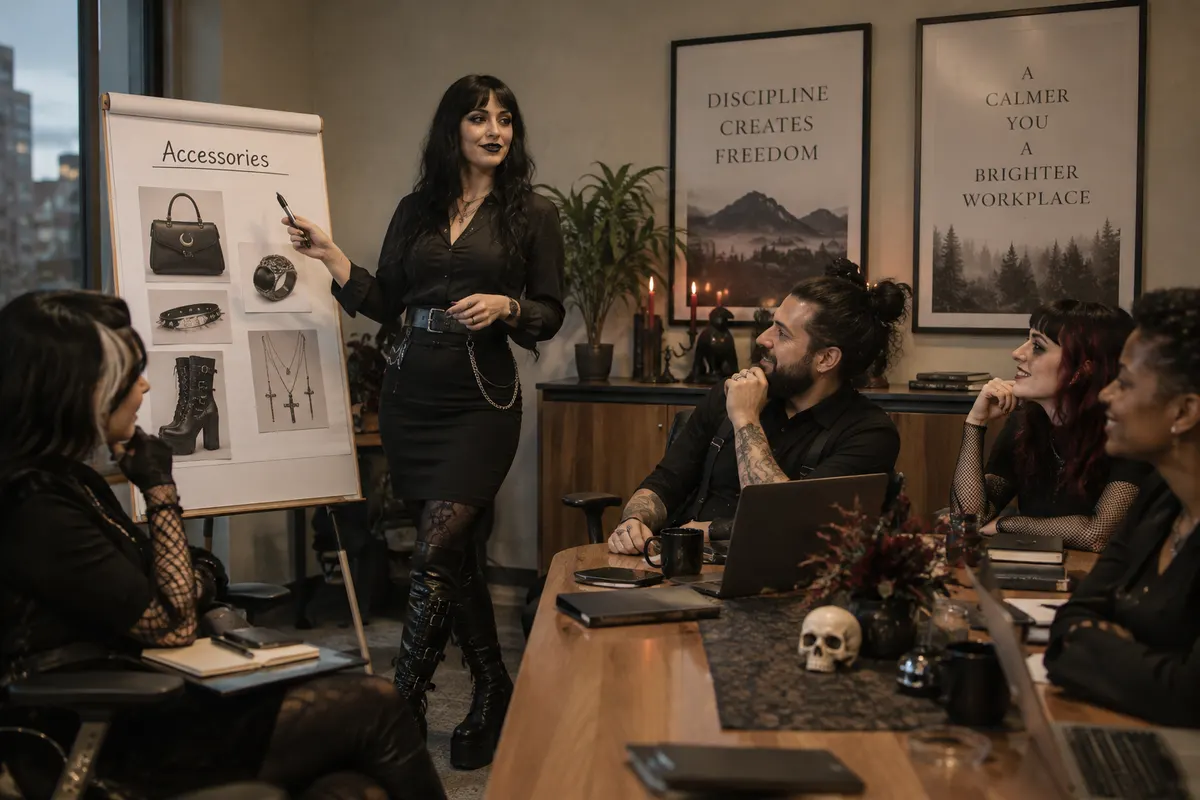
Morgan Vale knew the email was trouble before she opened it.
The subject line was too cheerful.
Exciting Opportunity: Culture Alignment Listening Circle!
Nothing good had ever happened after an exclamation point in Arial.
She sat at her desk on Monday morning with one platform boot hooked around the base of her chair, black coffee cooling beside her keyboard, and the tiny skull on her monitor wearing a paper crown left over from Brightway After Dark. The crown had been Bryce’s idea. The skull had accepted it with more dignity than most executives accepted feedback.
Across the aisle, Greg stood frozen outside his office, holding a banana and staring at his own laptop through the glass wall.
Morgan lifted one black-polished finger. “You got it too.”
Greg turned slowly. He wore a charcoal blazer today, which for Greg was basically a leather trench coat in a thunderstorm. “I don’t want to make assumptions.”
“You are holding your banana like a stress candle.”
He looked down. “It has potassium.”
“It also has fear.”
Tasha Green appeared from the supply closet with a box of printer toner on one hip and a lanyard full of keys jangling like a tiny administrative tambourine. Her cardigan was navy to the untrained eye, but Morgan spotted the barely visible embroidered raven on the cuff.
“Did everyone get the Listening Circle invite?” Tasha asked.
Bryce rolled his chair backward from Sales Island, where three identical water bottles and a ring light lived in uneasy harmony. “If by Listening Circle you mean Corporate Accessory Court, yes.”
Morgan clicked open the email.
In response to ongoing conversations about workplace professionalism, personal expression, and client-facing clarity, HR is forming a cross-functional listening circle to discuss visible subculture accessories in shared workspaces.
Morgan read the sentence twice.
Then once more, out of respect for the semicolons that had clearly perished before publication.
“Visible subculture accessories,” she said.
Greg winced. “It may not be about you.”
Morgan looked down at herself: black blouse with tiny velvet buttons, silver bat necklace, long black skirt, patent platform boots, and a ring shaped like a sleepy moon.
Tasha looked down at Morgan too. “It is eighty-seven percent about you.”
Bryce raised a hand. “And thirteen percent about my new cuff.”
He held up his wrist. Around it was a black leather bracelet with a small silver stud. It was the mildest object Morgan had ever seen claim rebellion.
Morgan leaned back. “Bryce, that cuff looks like it asks permission before crossing the street.”
“It’s a gateway cuff,” Bryce said defensively. “Eleanor said I should start with something that won’t scare my quarterly targets.”
At the sound of her name, Eleanor emerged from Accounting with a folder tucked under one arm. She was wearing her usual pale blouse, sensible shoes, and a brooch shaped like a black enamel spider so elegant it seemed to have its own pension plan.
“I said no such thing,” Eleanor said. “I said if you’re going to wear leather, condition it properly.”
Bryce nodded solemnly. “Mentorship.”
Morgan scanned the rest of the email. The Listening Circle would convene at eleven in Conference Room A, also known as the Room of Artificial Ferns. Attendees included HR, leadership, one representative from Client Success, Greg, and—because the universe enjoyed symmetry—Morgan.
There was one line at the bottom in bold:
Please bring an open mind and any concerns regarding visual cohesion.
Morgan sipped her coffee. “Visual cohesion.”
Tasha set the toner box down with a thud. “That means beige.”
Greg tried to smile and produced something shaped like dental anxiety. “Let’s not pre-write the outcome.”
“Greg,” Morgan said gently, “they scheduled a committee because my necklace has wings.”
“It has tasteful wings,” he said quickly.
Eleanor adjusted her spider brooch. “Conference Room C. Ten-thirty. Emergency lunch club.”
“It’s morning,” Bryce said.
Eleanor gave him a serene look. “Lunch is a concept, Mr. Caldwell.”
Conference Room C had become the unofficial headquarters of the secret goth lunch club, though “secret” was doing generous labor. The room now contained a black velvet table runner Tasha claimed was “seasonal,” a stack of napkins printed with tiny moons, and a whiteboard where someone—Greg, based on the very nervous handwriting—had written:
AGENDA: Accessories, Feelings, Boundaries, Maybe Scones
Morgan stood at the front with a marker. “Let’s assess the threat.”
Bryce opened his laptop. “I made a deck.”
Everyone stared at him.
“What?” Bryce asked. “You people taught me aesthetics and now I have powers.”
He connected to the screen. A slide appeared: VISIBLE SUBCULTURE ACCESSORIES: A VIBE-BASED RISK MATRIX. The background was black with a purple gradient. In the corner, a tiny animated bat flapped once and vanished.
Greg whispered, “Oh no. I love it.”
Tasha folded her arms. “Bryce, did you build this during pipeline review?”
“No,” Bryce said, then paused. “Adjacent to pipeline review.”
The matrix plotted accessories along two axes: Client Confusion and Personal Joy. Items included skull rings, band pins, lace cuffs, statement boots, dark lipstick, tasteful chains, “Eleanor’s spider of fiscal authority,” and, for reasons known only to Bryce, “Greg’s forbidden concert tee.”
Greg nearly dropped his scone. “It is not forbidden.”
“You keep it in a garment bag,” Morgan said.
“It’s vintage.”
“It’s in witness protection.”
Eleanor studied the chart. “The problem is not accessories. The problem is anxiety pretending to be policy.”
Morgan pointed at her with the marker. “Exactly. So we give them policy. Clear, boring, useful policy.”
Tasha clicked her pen. “We already got black recognized as a professional neutral. We can build on that.”
“Professional neutral,” Bryce repeated fondly. “I used that phrase at a client dinner and someone from procurement nodded like I’d solved weather.”
Morgan wrote on the whiteboard:
- Safety
- Function
- Client context
- No viewpoint discrimination
- Joy is not a compliance issue
Greg raised his hand.
Morgan blinked. “Greg, this isn’t school.”
“Force of habit.” He lowered his hand halfway, then put it up again. “What if HR is trying to prevent something genuinely disruptive?”
“Then we help them define disruptive,” Morgan said. “Dangling earrings near machinery? Sure. Giant hat blocking a presentation screen? Maybe. A bat necklace during a Zoom call? The bat can stay.”
“The bat should have voting rights,” Bryce said.
“The bat has seniority,” Tasha said.
Eleanor opened her folder and removed a single sheet of paper. “I took the liberty of reviewing the current dress code.”
Morgan accepted it. “Eleanor, did you annotate this?”
“In red.”
“There are footnotes.”
“There were opportunities.”
Greg leaned in and read one aloud. “‘The phrase distracting accessories is functionally meaningless unless the company is prepared to define distraction as anything that causes thoughts.’” He looked up, awed. “That’s beautiful.”
Eleanor gave a modest shrug. “I had coffee.”
By ten-fifty-five, they had a plan. Morgan would be calm, precise, and absolutely not let anyone turn her wardrobe into a team-building exercise. Greg would support with manager language, which meant saying things like “clear guardrails” and “equitable standards” without fainting. Tasha would track practical implications. Bryce, not officially invited, would provide moral support from the hallway and possibly refreshments. Eleanor would attend as Accounting’s representative because, as she put it, “everyone behaves better when they suspect the budget is watching.”
At eleven sharp, Morgan walked into Conference Room A.
The artificial ferns were thriving in their own plastic way. A tray of beige cookies sat in the center of the table. Someone had selected oatmeal raisin, the cardigan of desserts.
Diane from HR stood by the screen in a coral blazer and a smile that had been through several workshops. Beside her sat Marcy from Leadership, a woman who wore cream-colored suits with the confidence of a person who had never spilled coffee in public. There was also Owen from Client Success, Greg, Eleanor, Tasha, and two managers Morgan vaguely recognized from departments with acronyms.
“Morgan!” Diane said. “Thank you for joining this safe and generative space.”
Morgan took a seat. “Happy to contribute to the circle.”
Greg sat beside her and whispered, “Strong opening.”
“I haven’t started.”
“I know. Still.”
Diane clicked to the first slide.
VISUAL COHESION IN A MODERN WORKPLACE
The slide contained a stock photo of five people laughing near a laptop. Every single person in the photo wore beige, white, or light blue. Morgan wondered where stock photo offices stored their shadows.
Diane clasped her hands. “We want to begin by emphasizing that Brightway values individuality.”
Eleanor’s pen hovered over her notebook like a hawk over a field mouse.
Diane continued. “At the same time, we’ve received some questions about how personal style intersects with our evolving brand presence, especially now that Brightway After Dark has brought more visibility to our team.”
Morgan smiled politely. “What kind of questions?”
Diane clicked her pen. “General ones.”
“From whom?”
“Various stakeholders.”
“What did they ask?”
There was a tiny pause. In it, Morgan could hear the distant hum of the vending machine and, somewhere beyond the wall, Bryce coughing in what sounded suspiciously like encouragement.
Marcy leaned forward. “Some team members are wondering whether certain accessories might send the wrong message.”
“What message?” Morgan asked.
Owen from Client Success cleared his throat. “For example, if a client sees a skull, they might associate that with, you know.”
“Pirates?” Tasha offered.
“Motorcycle accountants?” Greg said, then looked startled by his own contribution.
Eleanor’s mouth twitched.
Owen adjusted his tie. “Negativity.”
Morgan touched the tiny skull charm at her wrist. “The skull is a centuries-old symbol used in art, fashion, medicine, philosophy, safety signage, and at least three extremely expensive designer collections. It can mean mortality, humor, anatomy, remembrance, or simply that someone likes skulls.”
Diane nodded slowly. “That’s helpful context.”
“It can also mean the wearer understands deadlines,” Eleanor said.
Greg made a noise that might have been a laugh trying to escape through a spreadsheet.
Marcy folded her hands. “No one is asking anyone to stop being themselves.”
“That’s good,” Morgan said. “Because that would be difficult to measure and illegal in several directions.”
Greg stared at the table with the expression of a man watching fireworks indoors.
Morgan kept her tone warm. “I think the issue is that ‘visible subculture accessories’ is too broad to be useful. It can cover my bat necklace, Bryce’s bracelet, Eleanor’s brooch, someone’s sports lanyard, a rainbow pin, a religious symbol, a charity wristband, or a client gift. If we regulate by vibe, we create confusion.”
Tasha leaned in. “And confusion creates enforcement problems. Who decides what counts as subculture? HR? Managers? A spreadsheet? The artificial fern?”
Diane glanced involuntarily at the fern.
“The fern has seen things,” Greg murmured.
Morgan continued. “A better standard is practical: safety, job function, and clearly defined client context. If an accessory creates a physical hazard, blocks communication, contains offensive language, or violates an existing policy, address that. Otherwise, personal style is not a problem to solve.”
Owen looked thoughtful. “What about client-facing days?”
“What about them?” Morgan asked.
“Well, certain clients are more traditional.”
Morgan nodded. “Then define expectations for the meeting. Not identities. If a client meeting requires business formal, say business formal. But business formal can include black, silver, modest jewelry, dark lipstick, and shoes that suggest the wearer knows where the good coffee is.”
Tasha said, “That last part may be harder to codify.”
“I’m willing to workshop.”
Marcy tapped her pen. “The concern is consistency.”
Eleanor slid a paper across the table. “I have drafted suggested language.”
Diane blinked. “You drafted suggested language?”
“I enjoy hobbies.”
Morgan glanced at the sheet and nearly grinned. Eleanor’s draft was clean, exact, and devastatingly reasonable. It permitted accessories unless they created a safety risk, contained discriminatory or explicit content, prevented job duties, or conflicted with a specific event dress standard communicated in advance. It also included a line requiring that enforcement be applied consistently across styles, departments, and seniority levels.
Greg read it and sat up straighter. “This is actually very aligned with the direction we took during the dress code update.”
Morgan saw Diane register the magic phrase: aligned.
Greg continued, voice gaining strength. “The regional showcase win happened because the team trusted specificity. Our brand got stronger when it stopped trying to be invisible. I think our internal culture works the same way.”
The room went quiet.
Not awkward quiet. Listening quiet.
Morgan looked at Greg. He was still nervous—Greg might have been assembled from nerves and calendar invites—but he did not retreat.
Marcy softened. “That’s a compelling point.”
Owen nodded. “Clients responded well to the After Dark work because it felt confident.”
“Exactly,” Morgan said. “Confidence is cohesive. Beige is just a color.”
Tasha coughed delicately. “A color with a lot to answer for.”
Diane smiled despite herself. “What I’m hearing is that the policy should focus on impact rather than aesthetic category.”
“Yes,” Morgan said.
“And that the phrase ‘visible subculture accessories’ may not be ideal.”
“It sounds like a museum label written by a nervous intern,” Eleanor said.
Greg whispered, “Eleanor.”
“What? I said museum.”
Diane made a note. “Perhaps we call this the personal presentation guideline.”
Morgan tilted her head. “Not bad.”
Marcy looked around the table. “Could we turn this into a one-page guide? Something managers can apply without making employees feel singled out?”
Morgan glanced at Tasha. Tasha’s expression said: here comes more work, but at least it is our flavor of work.
“We can help,” Morgan said.
Greg nodded. “Yes. Cross-functional, clear guardrails, practical examples.”
Bryce’s voice floated faintly from the hallway. “Add pictures!”
Everyone turned toward the door.
There was a muffled silence.
Then Bryce opened it two inches. “I was passing by.”
Tasha stared at him. “With a tray of coffees?”
“Hydration support.”
Diane looked amused. “Would you like to join us, Bryce?”
Bryce stepped in, wearing his gateway cuff and the expression of a man accidentally invited into history. “I have thoughts on visual examples.”
Morgan leaned back. “This should be educational.”
By noon, the Listening Circle had become something dangerously close to productive.
Bryce argued that examples should include multiple styles, not just “acceptable” and “too much,” because “too much for whom” was how companies wandered into chaos wearing loafers. Tasha suggested a manager decision tree. Eleanor removed three vague adjectives with the icy precision of someone defusing a bomb. Greg proposed adding a section called When in Doubt, Ask About Function, Not Taste, then looked so pleased with himself that Morgan almost applauded.
Diane updated the slide deck in real time. The stock photo disappeared, replaced by a simple heading:
PERSONAL STYLE & PROFESSIONAL FUNCTION
Morgan’s bat necklace remained unbothered.
When the meeting ended, Marcy gathered her notes. “Morgan, could you and Greg present the revised guide at next week’s all-hands?”
Greg’s smile froze. “All-hands.”
Morgan did not miss a beat. “Sure.”
Greg turned to her with eyes that said, please remember I am delicate office pottery.
She patted his folder. “We’ll build speaker notes.”
Marcy nodded. “Great. And maybe keep it light. People get nervous about dress code topics.”
“They do?” Morgan said, looking directly at Greg.
Greg took a very focused sip from an empty coffee cup.
Outside Conference Room A, Bryce exhaled dramatically. “We lived.”
Tasha checked her phone. “You were invited for the last seventeen minutes.”
“The most important seventeen minutes.”
Eleanor tucked her annotated dress code into her folder. “You said ‘loafers’ with conviction.”
Bryce beamed. “Thank you.”
Morgan headed back toward her desk, but stopped when she saw a small cluster near Sales Island. Three employees from Client Success were gathered around Priya, one of the project coordinators, who was showing them a pin on her blazer shaped like a tiny silver comet.
“Is this okay now?” one of them asked as Morgan passed.
Morgan paused. “Was it causing a safety hazard?”
“No.”
“Blocking communication?”
“No.”
“Bearing offensive language?”
“It’s a comet.”
“Then enjoy space.”
Priya grinned. “Thanks.”
By two o’clock, the office had changed in small ways.
Not dramatic ways. No one had overturned a copier or replaced the lobby fern with a fog machine. But Morgan noticed details blooming through the beige like stubborn little night flowers. A data analyst wore emerald nail polish. Owen from Client Success had a lapel pin shaped like a typewriter. Someone in Operations had swapped their plain lanyard for one printed with tiny ghosts. Greg, after forty minutes of visible internal debate, removed his standard company lanyard and replaced it with a black one patterned with subtle gray sound waves.
Morgan noticed immediately.
Greg pretended not to notice her noticing.
“Nice lanyard,” she said.
He looked at his monitor. “It was in my drawer.”
“For how long?”
“Time is a flat circle.”
“Is that a Depeche Mode waveform?”
He clicked his mouse with unnecessary force. “It is an abstract pattern.”
“Greg.”
He sighed. “It’s from a tour poster.”
Morgan smiled. “Professional. Neutral. Extremely you.”
Greg’s shoulders relaxed by half an inch, which for him was practically a dance break.
At three, the secret goth lunch club convened again, this time with actual lunch. Tasha had brought leftover pasta salad in a container big enough to serve a youth soccer team. Bryce contributed black sesame crackers, which he called “on theme.” Eleanor produced dark chocolate squares from her bag with magician-like calm.
Morgan set the draft guide in the center of the table.
“Today was good,” Tasha said.
“It was suspiciously good,” Bryce replied. “I kept waiting for someone to say skulls reduce synergy.”
“They still might,” Greg said. “At all-hands. In front of everyone.”
Morgan pointed a fork at him. “No spiraling before dessert.”
“I’m not spiraling. I’m pre-circling.”
Tasha groaned. “Greg.”
He looked faintly proud. “I made a joke.”
“It was terrible,” Eleanor said. “Promising.”
Bryce leaned across the table. “So if the all-hands goes well, is the lunch club still secret?”
Everyone looked around Conference Room C. The velvet runner, the moon napkins, the tiny plastic bat taped under the wall-mounted screen, the black sticky notes, the skull-shaped salt shaker someone had smuggled in after the Beige Bash.
Morgan considered lying.
Before she could answer, there was a knock.
The door opened and Priya poked her head in. She was still wearing the comet pin.
“Hi. Sorry. Is this…” She glanced at the velvet runner. “Is this the lunch thing?”
Bryce sat up. “There are rumors?”
Priya stepped in, followed by Owen with his typewriter pin and a woman from Analytics whose emerald nails flashed as she waved. Behind them, two more employees hovered with the hopeful awkwardness of people who had found a party they were not sure they were invited to.
Tasha whispered, “Secret goth lunch club has a leak.”
Eleanor calmly unwrapped a chocolate square. “All institutions evolve.”
Priya held up a lunch bag. “We don’t want to intrude. It’s just that after the meeting, people were saying this is where the non-beige conversations happen.”
Greg looked at Morgan.
Bryce looked at Morgan.
Tasha looked at Morgan.
Eleanor looked at Morgan, but in the way Eleanor looked at a tax form: already aware of the answer, waiting to see if others caught up.
Morgan thought about her first day at Brightway, when the beige walls had seemed less like a color scheme and more like a warning. She thought about the dress code meeting, the Halloween party, the culture video, the rebrand, the showcase, Greg’s hidden band shirt, Bryce’s gateway cuff, Tasha’s raven cuff, Eleanor’s spider brooch, and the tiny skull on her monitor wearing a paper crown.
Then she looked at Priya’s comet pin.
“This is the lunch thing,” Morgan said. “There are rules.”
Priya straightened. “Okay.”
“Rule one: no mocking someone’s harmless joy.”
Owen nodded. “Good rule.”
“Rule two: if you bring oatmeal raisin cookies, you must label them clearly so no one mistakes them for chocolate chip and loses trust in the universe.”
“Essential,” Tasha said.
“Rule three,” Morgan continued, “you don’t have to be goth. You just have to respect the table.”
The Analytics woman smiled. “I’m mostly into synthwave and antique teacups.”
Eleanor gestured to an empty chair. “Acceptable.”
Bryce moved his bag from the chair beside him. “Welcome to the non-beige conversations.”
Within five minutes, Conference Room C was full.
People perched along the wall with lunch containers balanced on knees. The conversation bounced from pins to playlists to client decks to which office plants looked most haunted. Greg, overwhelmed but pleased, found himself explaining the difference between a playlist for focus and a playlist for “staring out a rainy window with purpose.” Tasha gave practical advice about office-safe boots. Bryce showed Priya his vibe matrix and received immediate feedback that “Personal Joy” needed a bolder font. Eleanor listened to a junior accountant describe collecting vintage postcards and recommended three estate sale neighborhoods with unsettling specificity.
Morgan watched the room with a strange, bright feeling in her chest.
Not victory, exactly.
More like ventilation.
As if someone had opened a window in the beige and let in weather.
Her phone buzzed.
A notification from Alt Chat lit the screen. The Hangout room she and Tasha occasionally lurked in—Nine-to-Five Night Creatures—had a new thread.
Tasha, across the room, checked her phone at the same time. Her eyebrows rose.
Morgan opened the thread.
Anyone else dealing with office dress code weirdness after a rebrand? Need advice before my company bans my boots.
Below it, someone had already replied:
Ask whether the policy regulates function or taste. If it’s taste, make them define it.
Morgan looked closer at the username.
FiscalBatcave80.
She slowly turned toward Eleanor.
Eleanor took a sip of tea from a mug that said World’s Okayest Spreadsheet Goblin and did not blink.
Morgan leaned over. “FiscalBatcave80?”
Eleanor’s expression remained serene. “I contain multitudes.”
Tasha burst out laughing so hard she had to put down her fork.
Greg glanced between them. “What happened?”
“Eleanor is giving office style policy advice on Alt Chat,” Morgan said.
Greg looked impressed. “Of course she is.”
Bryce pointed at Eleanor. “Wait, are you the person who told me online last week that my cuff needed conditioner?”
Eleanor gave him a mild look. “Did your cuff improve?”
Bryce touched the bracelet. “Actually, yes.”
“Then you’re welcome.”
The room erupted into overlapping laughter and questions. Eleanor accepted all of it with the calm of a retired queen receiving tribute.
Then Greg’s laptop chimed.
He opened it, still smiling.
The smile vanished.
Morgan noticed first. “What?”
Greg turned the screen toward her.
A new calendar invite filled the display.
URGENT: All-Hands Prep — Executive Review of Personal Style Guide
Invited: Greg, Morgan, Diane, Marcy, Tasha.
Location: Executive Boardroom.
Time: Tomorrow, 8:00 a.m.
Attached file: Personal_Style_Guide_REVISIONS_FROM_LEADERSHIP.docx
Morgan clicked the attachment.
The revised title loaded.
BRIGHTWAY VISUAL HARMONY POLICY
Under it, in track changes, someone had added the sentence:
Employees should avoid accessories that create an unintended dramatic impression.
Morgan stared at the words.
Tasha leaned over her shoulder. “Unintended dramatic impression?”
Bryce made a choking sound. “That’s just Greg walking into a room with a banana.”
Greg closed his eyes. “I knew the potassium would come back for me.”
Eleanor set down her tea.
Very carefully.
Morgan felt the whole crowded room waiting.
She smiled.
It was not a sweet smile. It was a black-lipstick smile. A velvet-slide, regional-showcase, bats-have-seniority smile.
“Well,” she said, “I guess tomorrow we define drama.”