Velvet Slides and Regional Panic
Corporate Goth · Chapter 7
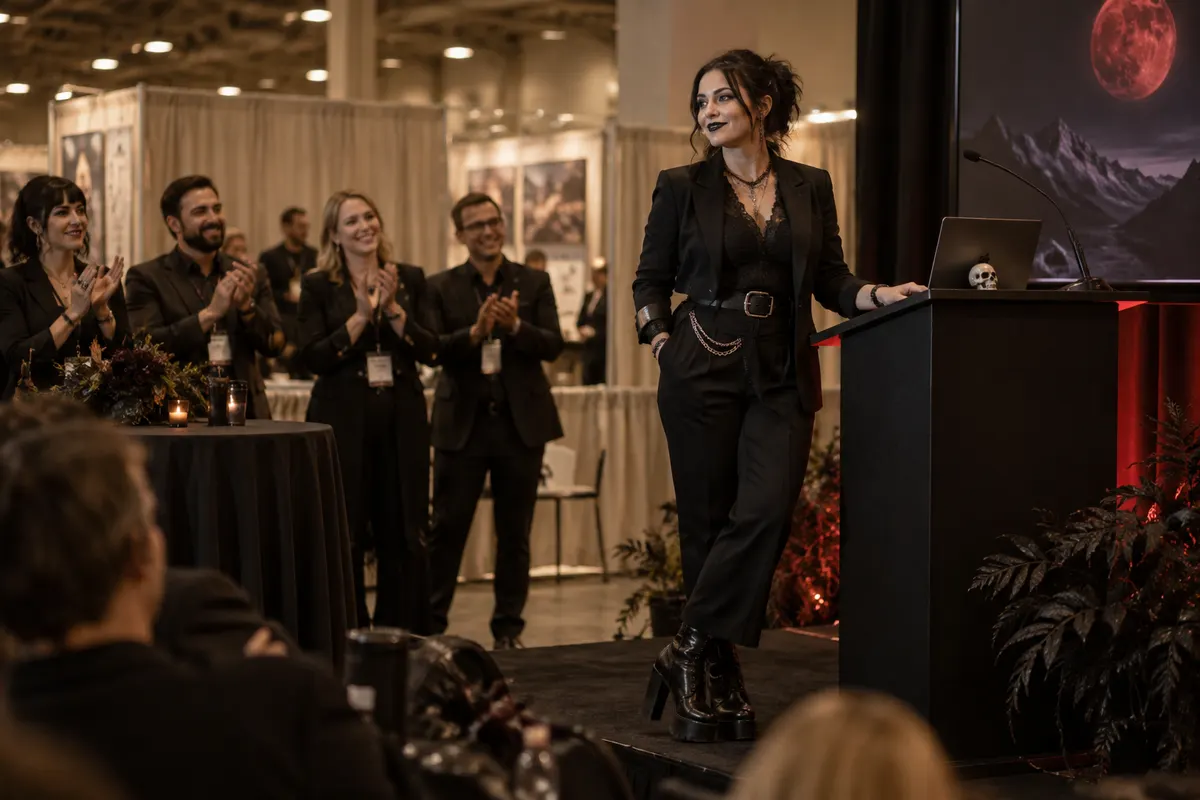
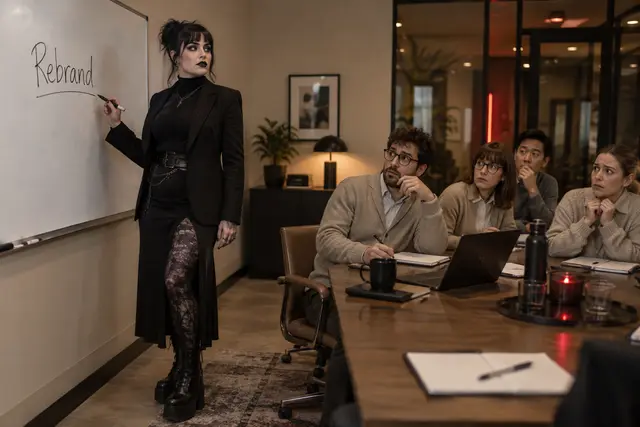
By 8:12 on Tuesday morning, Conference Room C had become less of a meeting space and more of a dramatic understudy waiting to go on.
Morgan Vale stood at the head of the table in a black blazer with satin lapels, lace-up boots that added three inches of authority, and lipstick so dark it made the overhead lights reconsider themselves. Her tiny skull, temporarily relocated from her monitor to the conference table, sat beside the laptop like a ceremonial judge.
On the screen: REGIONAL CREATIVE SHOWCASE — BRIGHTWAY AFTER DARK PRESENTATION V7_FINAL_FINAL_ACTUAL_FINAL.
Tasha Green, office manager, closet metalhead, minivan captain, and newly self-appointed keeper of the clicker, narrowed her eyes at the title slide.
“Take off one ‘final,’” she said.
“No,” Morgan said. “The number of finals indicates suffering. It’s part of the narrative.”
Bryce leaned back in his chair, wearing a charcoal button-down that he had clearly described to himself as “dangerous.” His hair was still very sales-floor perfect, but he had added a tiny black enamel pin to his collar in the shape of a lightning bolt.
“I like the suffering,” he said. “It makes us sound premium.”
Eleanor from accounting, quiet as a locked diary and twice as interesting, adjusted her silver spectacles. Today she wore a long black cardigan, a cameo brooch, and boots that looked like they had once judged a nightclub.
“The suffering could be more legible from the back row,” she said.
Greg hovered near the door with a stack of printed agendas pressed to his chest. He wore his usual office khakis, but under his beige zip sweater—still a zip sweater, despite all reforms—Morgan could see the edge of a black T-shirt. A vintage one. Faded. Sacred.
“You’re wearing it,” Morgan said.
Greg froze. “Wearing what?”
“The shirt.”
“What shirt?”
“The shirt that says you know at least three b-sides and have opinions about synth drums.”
Tasha gasped. “Greg.”
Greg looked at the carpet as if it might provide witness protection. “It’s just a shirt.”
Eleanor smiled without showing teeth. “That is what everyone says before history notices them.”
The regional creative showcase was two days away: a half-day event hosted in a downtown hotel ballroom, attended by marketing firms, partner agencies, local business leaders, and at least one person who would use the phrase “disruptive storytelling” while holding a lukewarm muffin. Brightway had been invited after the success of Brightway After Dark, the rebrand launch that had somehow turned the company’s fear of color contrast into a polished evening of velvet table runners, blackberry mocktails, and one tiny brand bat.
The tiny brand bat had become, against all odds, an internal celebrity.
It appeared now on slide six, perched discreetly near the Brightway logo.
Bryce pointed at it. “I still think the bat needs a name.”
“No,” Greg said quickly. “We are not naming the bat before a regional showcase.”
“We named three ficus plants in the lobby,” Tasha said.
“That was different. They were morale infrastructure.”
Morgan clicked to the next slide. “Focus. We have ten minutes on stage, five for questions, and unlimited opportunity for someone from leadership to accidentally say ‘edgy’ like it’s a loose raccoon in the ceiling.”
Greg winced. “Please don’t say raccoon. Denise has been practicing.”
Denise, Brightway’s VP of Client Experience, had been enthusiastic about the showcase in the manner of someone who had discovered applause and wanted to franchise it. She loved the phrase “bold but approachable,” which Morgan did not hate, but Denise also kept asking whether Morgan’s outfit for the presentation would be “the friendly version of black.”
Morgan had replied, “Yes. It only bites if cornered.”
This had not made it into the official prep notes.
Tasha raised the clicker like a baton. “Run-through. From the top. Greg, you introduce. Morgan, you explain the creative pivot. Bryce, you talk client response. Eleanor, you deliver the numbers and emotionally destroy anyone who doubts us.”
Eleanor nodded. “With grace.”
“With grace,” Tasha agreed.
Greg shuffled his agendas. “Great. Wonderful. Love the energy. Let’s circle—”
Everyone looked at him.
He swallowed. “Let’s begin.”
Morgan put a hand over her heart. “Growth.”
Greg’s introduction began well, which for Greg meant he used only two corporate phrases in the first minute and did not once apologize to the projector. He talked about Brightway’s original beige rebrand challenge, the need for authenticity, and the way the team had discovered that professional did not have to mean invisible.
Then he clicked too soon.
A slide appeared showing a backstage photo from the Brightway After Dark launch: Bryce holding a tray of blackberry mocktails with the terror of a man entrusted with rare jewels, Tasha adjusting a velvet runner, Eleanor standing beneath uplighting like a legendary club promoter, and Morgan pointing at a centerpiece with the severity of a war general.
Greg blinked. “Ah. Well. This is… team in action.”
“Great save,” Bryce whispered.
“Not a save,” Eleanor murmured. “A stumble with posture.”
Morgan took over, letting the room settle into rhythm. She walked them through the logic of the rebrand: Brightway had not become gothic; it had become more specific. The contrast, the deeper palette, the sharper typography, the honesty in the culture video, the restraint of the bat.
“The bat is very restrained,” Bryce said when his turn came. “Honestly, more restrained than most sales decks I’ve seen.”
“Bryce,” Greg said gently.
“Right. Client response.” Bryce straightened. “Clients liked that we stopped pretending every company is a stock photo of people laughing at salad. They said the new direction felt more memorable, more confident, and less like an oatmeal packet learned Canva.”
Tasha clutched the clicker. “That exact phrase stays.”
Greg made a noise halfway between concern and admiration.
Eleanor finished with the numbers. Engagement at the launch. Positive client feedback. Social mentions. Internal survey responses. She delivered every figure calmly, as if revealing clues in a drawing room.
When she said, “Ninety-one percent of staff reported that the new direction felt more authentic to Brightway’s actual team culture,” Morgan saw Greg stand a little taller.
When she said, “And seventy-eight percent now agree that black can be used as a professional neutral,” Tasha pumped both fists silently beneath the table.
Bryce mouthed, “History.”
The run-through ended at nine minutes and forty-two seconds.
Greg checked his watch. “That’s good. That’s very good. We have eighteen seconds of buffer.”
Morgan closed the laptop. “Eighteen seconds is a mansion.”
Tasha’s phone buzzed. She looked down, then made a face.
“What?” Morgan asked.
Tasha turned the screen toward them.
An email from Denise. Subject line: SHOWCASE ALIGNMENT NOTE!!!
Morgan read aloud. “Team, so excited for Thursday! Quick thought from leadership: since this is a broad professional audience, let’s ensure our look says creative confidence without going too niche. Maybe less underground club, more elevated evening networking? Also, competitor agency Lark & Finch will be presenting before us, so let’s make sure we feel polished, not costume-y. Warmly, Denise.”
A silence landed.
Bryce frowned. “Lark & Finch? Aren’t they the ones with the website where every employee is leaning against exposed brick?”
“The very same,” Eleanor said. “Their managing director once described a spreadsheet as ‘emotionally agile.’”
Greg rubbed his forehead. “Okay, let’s not spiral. Denise is just… pre-panicking.”
Morgan stared at the word costume-y until it became a tiny paper cut.
Tasha set the clicker down carefully. “We are not doing this again, are we?”
“No,” Morgan said.
Her voice was light. Too light. The kind of light that made Bryce sit up.
“We are not re-litigating black,” Morgan continued. “We have case studies. We have metrics. We have a bat with brand discipline. If Lark & Finch wants exposed brick and linen sneakers, they can have them. We are not sanding off the part that worked because someone got startled by velvet.”
Greg nodded quickly. Then slower. Then with actual intent.
“You’re right,” he said.
Everyone turned.
He noticed, panicked for half a second, and then stayed standing. “You’re right. The reason the event worked is because it was specific. If we show up and pretend it was beige with dimmer lights, that’s not accurate. And it’s not fair to the team.”
Morgan looked at him. “Gregory.”
“Please don’t full-name me during a confidence moment.”
“Understood.”
Tasha smiled. “So what do we tell Denise?”
Greg exhaled. “I’ll tell her we hear the concern and will ensure a polished presentation while preserving the strategy’s core creative integrity.”
Bryce pointed. “That sounded expensive.”
“It felt expensive,” Greg said, mildly stunned.
Morgan opened the laptop again. “Good. Then we rehearse once more. And this time, Greg, don’t fear the backstage slide. It only reveals that we know how to work in low lighting.”
On Thursday morning, the downtown hotel ballroom smelled like coffee, carpet, and ambition.
The showcase registration table was draped in white cloth. The lanyards were orange. The pastries were arranged with the forced cheer of people who did not know they were about to be ignored for networking.
Morgan arrived in a tailored black suit with a sheer high-neck blouse layered over an opaque camisole, platform boots polished to a mirror shine, and a narrow silver chain at her collar. Her lipstick was the shade of a locked door at midnight.
Tasha wore a deep plum blazer over a black dress and had braided a thin strip of dark ribbon into her hair. She carried a tote bag containing emergency safety pins, backup chargers, mints, blotting papers, a lint roller, and, inexplicably, a tiny screwdriver.
“For morale infrastructure,” she said when Morgan noticed.
Bryce wore a black suit, no tie, and the lightning-bolt pin. He kept checking his reflection in darkened windows.
“I look like I sell haunted condos,” he said.
“You look like you finally read the room and the room had a bassline,” Morgan said.
He grinned. “I’ll take it.”
Eleanor arrived last, elegant in a long charcoal coat and red lipstick so precise it deserved its own accountant. Greg appeared beside her, clutching the laptop bag. His beige sweater was gone. Over his button-down, he wore a dark blazer. Beneath it, barely visible unless you knew to look, was the vintage black T-shirt.
Morgan noticed. Tasha noticed. Bryce noticed. Eleanor had absolutely noticed before entering the building.
Greg held up one finger. “No one.”
“Of course,” Morgan said.
“Never,” Tasha said.
“Your secret is safe with us,” Bryce said, with the solemnity of a man who had already planned three jokes.
Their assigned booth was between a promotional products company displaying branded stress balls and Lark & Finch, whose booth featured pale wood risers, cream brochures, and a large sign reading HUMAN-FIRST STORY ECOSYSTEMS.
Morgan stared at it.
Tasha leaned in. “Is that a threat?”
“It’s either a threat or a candle scent.”
A woman in a sand-colored suit approached from Lark & Finch with the serene smile of someone who owned twelve identical notebooks. Her badge read CLAIRE — STRATEGY DIRECTOR.
“Brightway,” Claire said. “We’ve heard so much about the After Dark thing.”
Thing.
Bryce’s sales smile appeared, bright and dangerous. “All good, I hope.”
“Oh, very buzzy,” Claire said. “It’s brave to lean so hard into theme.”
Morgan smiled. “It’s braver to call an ecosystem human-first and hope no one asks where the humans are.”
Tasha coughed into her fist.
Claire’s smile flickered. “Fun. Well, best of luck on stage.”
“You too,” Eleanor said. “Your brochures are very calm.”
Claire looked unsure whether that was praise.
When she left, Greg whispered, “Was that conflict?”
“Barely,” Morgan said. “That was a decorative skirmish.”
The morning sessions began with a keynote about attention spans, followed by a panel in which three people agreed that brands should be authentic in a way that sounded rehearsed. Morgan listened, took notes, and drew a tiny bat in the margin every time someone said “ecosystem.”
By the time Lark & Finch took the stage, the ballroom had warmed into that strange conference haze where coffee had become a food group and everyone’s shoes were quietly filing complaints.
Claire presented with a calm so polished it almost became weather. Their case study involved a wellness startup, a muted palette, and the phrase “soft disruption.” Their slides were beautiful. Their data was thin. Their typography had cheekbones.
Bryce leaned toward Morgan. “Do fonts have cheekbones?”
“That one does.”
Lark & Finch ended to respectable applause. Claire stepped down, glanced at Morgan, and smiled as if passing a baton that had been lightly cursed.
Greg went pale.
Tasha handed him a mint. “Not because your breath is bad. Because your soul left.”
“Thank you,” he whispered.
The ballroom moderator mispronounced Brightway as “Bright Ways,” plural, but Morgan decided to forgive him because his pocket square was trying. Greg walked up first, shoulders tight, laptop connected, clicker in hand.
The title slide appeared: BRIGHTWAY AFTER DARK: HOW SPECIFICITY SAVED A REBRAND.
The black background looked gorgeous on the huge screen. The logo glowed clean white. The tiny bat sat in the corner, restrained and iconic.
A few heads tilted. Good. Attention.
Greg looked out at the audience. For a second, Morgan saw his old reflex gather: apologize, soften, circle back into fog.
Then his hand brushed the edge of his blazer, where the hidden band shirt lived like a secret engine.
“Good morning,” Greg said. “I’m Greg from Brightway Solutions. Six months ago, if you had told me I’d be standing on a stage defending a tiny bat as a strategic asset, I would have asked whether we could schedule that conversation for a less alarming quarter.”
The audience laughed.
Morgan felt Tasha relax beside her.
Greg continued. “But that’s the story of this project. We thought we needed to become more polished by becoming less ourselves. It turned out the opposite was true.”
He handed off to Morgan.
She stepped into the stage lights and felt the room sharpen.
“Brightway had a beige problem,” she said. “Not the color itself. Beige can be lovely. I personally respect any neutral that survives office carpeting. The problem was that beige had become a hiding place.”
More laughter. A few nods.
“Our team was funnier, sharper, and more specific than our materials suggested. So the creative question became: how do we make confidence visible without turning the company into someone it isn’t?”
She clicked through the slides: the old palette, the proposed beige-on-beige refresh, the revised contrast system, the event photos, the culture video stills. She talked about restraint, clarity, humor, and the difference between decoration and identity.
“The bat,” she said, pausing on the tiny mark, “is not there because bats are spooky. The bat is there because memorable brands know when to stop explaining themselves.”
In the third row, someone wrote that down.
Morgan tried not to smile too much.
Bryce took his turn and did not say “oatmeal packet learned Canva,” because Greg had begged him not to right before they walked onstage. He did, however, say, “Clients responded to the sense that real people had made real choices,” which was annoyingly excellent.
Eleanor delivered the numbers with calm precision. When a slide showed the internal survey result about black as a professional neutral, a murmur passed through the audience.
Eleanor looked up. “We measured it because people kept having opinions. Data is a useful way to invite opinions to sit down.”
That got the biggest laugh of the presentation.
They ended at nine minutes and thirty-nine seconds. Greg’s eighteen-second mansion had become a twenty-one-second castle.
The moderator stepped up for questions.
A man from a design firm asked about stakeholder resistance. Morgan answered honestly: they had named the fear, connected creative choices to business outcomes, and made room for leadership to be surprised without making surprise the steering wheel.
A woman from a nonprofit asked whether the darker palette had limited accessibility. Tasha, from the front row, nearly levitated. Morgan clicked to the backup slide on contrast ratios and readability testing.
“Absolutely not,” Morgan said. “Mood is not an excuse for unreadable text.”
Tasha whispered, “Put that on my mug.”
Then Claire from Lark & Finch raised her hand.
“Lovely presentation,” she said. “I’m curious how you distinguish authenticity from aesthetic indulgence. At what point does a strong look risk overshadowing the actual business?”
There it was. The velvet tripwire.
Greg tensed.
Bryce’s smile became a blade.
Morgan kept her expression pleasant. “Great question. For us, the distinction is whether the look is doing a job. If it’s only there to impress the creative team, it’s indulgence. If it improves recognition, supports tone, clarifies hierarchy, and gives staff language they actually use, it’s strategy.”
Claire nodded, but Morgan wasn’t done.
“And frankly, every brand has an aesthetic. Some are just so common they get mistaken for neutrality.”
A small sound moved through the room: approval, interest, the collective pleasure of a clean point landing.
Eleanor’s mouth curved at one corner.
Greg looked like he had just watched someone parallel park a hearse in one try.
After the session, people came to the booth.
Not politely. Not in the sad trickle of conference obligation. They came with questions, business cards, and actual interest. Someone from a local arts nonprofit wanted to know if Brightway could help reposition a fundraising campaign. A brewery owner asked about “dramatic but not goofy” event branding. A woman from a software company said, “Our whole visual identity is blue rectangles and regret,” and Morgan handed her a card with deep respect.
Bryce entered a networking state that could only be described as athletic.
“Great to meet you. Yes, that was us. Yes, the bat tested well. No, we do not recommend adding bats to every brand. Unless the brand has earned the bat.”
Tasha watched him, impressed despite herself. “He’s learning boundaries.”
“Nature is healing,” Morgan said.
Greg stood near the booth, holding a paper cup of coffee he had forgotten to drink. Denise had texted him six exclamation points and the words SO GOOD. CALL ME AFTER. ALSO THE BAT???
He showed Morgan.
“She has questions,” he said.
“She has punctuation,” Morgan said. “Different emergency.”
Eleanor returned from a quiet lap of the ballroom with two mini quiches and a piece of intelligence.
“There’s a closing award,” she said.
Bryce blinked. “There are awards?”
“Apparently. Three. Audience pick, innovation, and best strategic pivot.”
Greg nearly spilled his coffee. “Why did no one tell us there were awards?”
Tasha checked the event booklet. “It’s on page twelve.”
“Who reads page twelve?”
“Accountants,” Eleanor said.
Morgan looked toward the stage, where the showcase staff were setting up three small glass plaques. She told herself she did not care about awards. Awards were shiny rectangles invented to make adults clap indoors.
Then she imagined the plaque on Brightway’s reception desk, right between the named ficus plants, and felt a small, ridiculous hunger.
“Oh no,” she said.
Tasha looked at her. “You want the shiny rectangle.”
“I want the shiny rectangle.”
“Good. Owning it is healthy.”
The closing session gathered everyone back into the ballroom. The moderator thanked sponsors, praised creativity, and used the word “journey” only twice, which Morgan considered merciful.
Audience pick went to a public transit campaign with funny bus ads. Fair. Innovation went to a digital studio that had built an interactive map for community resources. Also fair.
Best strategic pivot remained.
Greg’s knee bounced so fast it could have powered the projector.
“And the award for Best Strategic Pivot goes to…” The moderator opened the card. “Brightway Solutions, for Brightway After Dark.”
For one perfect second, their whole row froze.
Then Bryce said, too loudly, “BAT!”
Tasha made a delighted noise. Eleanor applauded with composed satisfaction. Greg looked at Morgan as if asking permission to believe it.
Morgan stood. “Come on, strategic asset.”
They walked up together: Greg, Morgan, Tasha, Bryce, Eleanor. The plaque was heavier than Morgan expected. The moderator handed it to Greg, who immediately handed it to Morgan, who handed it to Eleanor, who inspected it for spelling.
“Acceptable,” Eleanor said.
The photographer waved them closer. Bryce put a hand behind the group and whispered, “Do we smile like normal people or like we know something?”
“Both,” Morgan said.
The flash went off.
On the ride back to Brightway, Tasha drove the minivan because of course she had insisted they all ride together “for team cohesion and because parking downtown is a scam.” The award sat buckled into the middle seat, wearing Bryce’s suit jacket like a tiny honored guest.
Greg, in the front passenger seat, finally relaxed enough to laugh.
“I can’t believe we won,” he said.
“I can,” Eleanor said from the back. “But I enjoy that you can’t.”
Bryce was already typing in the secret goth lunch club room on Alt Chat, where Greg’s username—DMsOpenToDarkness—had posted only once before, a very formal hello with a bat emoji Tasha had described as “emotionally brave.”
Bryce read aloud as he typed. “Regional showcase conquered. Shiny rectangle acquired. Bat vindicated.”
“Do not make the bat weird,” Greg said.
“It was weird before me.”
Morgan looked out the window as the hotel disappeared behind them, replaced by lunch places, office towers, and a billboard advertising cloud solutions with a picture of a man pointing at nothing. Her reflection in the glass looked amused. Maybe proud. Definitely tired.
At a red light, Tasha glanced at her. “You okay?”
Morgan nodded. “Yeah. Just thinking.”
“Dangerous hobby.”
“The good kind.”
When they returned to Brightway, Denise was waiting in the lobby with half the leadership team and a sheet cake that had clearly been purchased in a hurry. In purple icing, it read: CONGRATS BRIGHTWAY AFTER DRAK.
Morgan stared.
“Drak,” Bryce whispered. “The bat has a name now.”
Greg closed his eyes. “No.”
Eleanor tilted her head. “Drak is concise.”
Tasha took a photo. “This is going in the archive.”
Denise swept toward them, beaming. “You were incredible! The whole thing was polished, confident, so us. And the bat? People loved the bat. I may have been wrong about the bat.”
Morgan accepted a plastic fork. “That’s how the bat gets you.”
Denise laughed, then lowered her voice. “Also, leadership wants to discuss expanding the rebrand rollout. More departments. More templates. Maybe a full internal brand guide refresh.”
Greg’s face flickered through pride, terror, and scheduling math.
“We can discuss scope,” he said, sounding only moderately haunted.
“Great,” Denise said. “Oh, and one more thing.”
Morgan paused with a forkful of cake halfway to her mouth.
Denise smiled wider. “The CEO saw the showcase photos. He wants to feature the team at next month’s all-hands. Maybe a little live Q&A. Maybe a behind-the-scenes panel. Very casual.”
Tasha stopped mid-photo.
Bryce whispered, “Define casual.”
Eleanor set the plaque on the reception desk between two ficus plants and folded her hands.
Greg made the face of a man watching his calendar catch fire in slow motion.
Morgan finally took the bite of cake. It was too sweet, slightly dry, and absolutely victorious.
She looked at the misspelled icing, the shiny rectangle, her strange little team, and the lobby that suddenly seemed less beige than it used to.
“Fine,” she said. “But if anyone asks me to make the all-hands less spooky, Drak and I are unionizing.”
From somewhere near reception, the printer coughed to life.
Tasha walked over, pulled out the first page, and read the subject line.
Her eyebrows climbed.
“What now?” Greg asked.
Tasha turned the paper around.
At the top, in bold letters, was an agenda invite from Human Resources:
EMPLOYEE EXPRESSION COMMITTEE — PROPOSED GUIDELINES FOR VISIBLE SUBCULTURE ACCESSORIES
Morgan slowly lowered her fork.
Bryce looked at her boots. Greg looked at his hidden shirt. Eleanor touched her cameo brooch.
The tiny skull, back on Morgan’s monitor across the lobby, seemed to grin.
Morgan smiled too.
“Well,” she said. “Drak’s first labor action came sooner than expected.”